
The Woman Who Mistook Herself for a Sociopath
I entered Harlem Middle School in Fall 1994 with a mouthful of braces, an overflowing training bra and a lingering attachment to Velcro shoes. I had no idea who Kriss Kross were, but I could recite facts from the Encyclopedia Britannica and The American Medical Association’s Family Medical Guide on command (and often without the explicit consent of my listener). I’d won The Young Georgia Authors’ contest the year prior and I was friends with at least one fellow tomboy who liked to play war games in the swamp with me. My mom and teachers thought I was pretty cool, so why didn’t everyone else?
I began to take note of the things most of the popular girls had in common: boyfriends, micro braids (this was the 90s) and relentless confidence. I had none of these things, but I suspected I might be able to fake my way, if not to the top, then at least some distance from my location at the bottom of the pecking order where I’d occupied ever since transferring from a private Montessori school to public school in 5th grade.
I acquired a boyfriend by strategically targeting the lowest hanging fruit. Chris was an adorable platinum blonde who’d yet to have his first serious run-in with puberty, leaving him a head shorter than most of his peers and rendering him invisible to every girl except me. And although Chris was hesitant to go official with someone so unpopular, my assurances that he didn’t even have to sit with me at lunch convinced him that the social cost would be offset by having everyone else in 6th grade see that he was a romantic contender in at least one person’s eyes.
My next task was to convince my grandmother to buy me a head full of trendy little braids, as she was the most easily swayed of my family members. After lecturing her on the urgent need to fit in, she agreed to take me to the local salon to see what could be done for my long, lank hair. The sweet, middle-aged woman who worked there patiently listened as I attempted to explain - without aid of pictures and a limited hairstyle vocabulary - what I wanted. I was going for Brandy-style box braids circa “I Wanna Be Down,” but by the time she finished, what I had was Bo Derek in “10.” Only I was no blonde, tanned and toned 10. I was a haphazardly pubescent girl with cornrows of dark hair starkly contrasted against a gleaming white scalp.
Lacking an appreciation for the subtle nuances in fashion, I figured it was close enough. I went to school the next day brimming with excitement over the compliments and interest that surely awaited me. Much to my disappointment, the day was uneventful. If anything, the other kids actually seemed to ignore me even more. Chris didn’t even give me the cursory greeting I’d come to expect during our week-old relationship. But this all changed by afternoon PE class when, as I shuffled about alone on the soccer field like I did on most days, I looked up to see a fairly popular classmate jogging out to greet me. My heart soared in anticipation.
“Chris wants to break up with you.”
I stared past her to the malformed bulldog mural painted on the side of the gymnasium.
“Why?” I asked.
“Because he says your hair looks stupid.”
There it was. The culmination of my failures summarized in one sentence fragment. Despite having been nicknamed “The Human Dictionary,” I always managed to stumble upon inventive ways to look stupid to my peers.
The problem never really got better, I just got better at faking it. I became a master imitator of those I admired. Their facial expressions and affectations replicated to perfection so long as I concentrated hard enough. But once I let down my guard just a little, the neat facade would begin to crumble, leaving me stranded somewhere between the Uncanny Valley and the person I really was.
My mother would come to label these periods of childhood mimicry with titles like my “Jim Carrey phase.” Other phases were more stoic and others more refined and feminine. By my mid-teens, I ended up settling on the persona that required the least work: Androgynous, blunt and professorial punctuated by intermittent bouts of crude schoolboy bombastics.
Despite my passable affect and ongoing penchant for dressing like a fashionable Ring Wraith, I never shook the unnerving suspicion that someone would eventually smell how uncool I was. Like when I stood in the middle of the room at parties, orbiting conversations before inserting myself at the exact moment I’d mustered enough courage to do so. Sometimes that moment happened to be when someone was midway through a deeply personal story. Other times, it was when both parties were just ending the conversation, leaving my introductory sentence to evaporate into the din of revelers.
My habit of butting-in, dominating discussions and blatant disregard for social convention did not go as undetected as I’d hoped. By age 19 it was clear that I’d been sniffed out, though not for simply being uncool.
During my freshman year of college, my best friend Mark asked me to meet him at my favorite bookstore haunt where I frequently lunched alone. After gently explaining how often I rubbed others the wrong way, he surmised not only that I “used my high intelligence to hide my deep social ineptitude,” but that all this evidence indicated that I might also be a sociopath.
A sociopath.
Of course. My knack for causing hurt feelings through casual interaction, my ruthless logic, my ability to watch autopsies while eating, my inability to process or even understand certain strong emotions in others, my quick temper when frustrated, my defiance of norms, even my practiced mimicry - everything was illuminated. I wasn’t uncool. I was just a sociopath who hadn’t yet perfected the ability to fool others with her mask.
So I took on the label and wore it quietly lest I replace the agitation I inspired in others with outright revulsion. While I didn’t love the notion of myself as a sociopath, deep down, for the first time in my life, I allowed myself to feel a little dangerous. To be excited and empowered by it. To convince myself that I was fearless and free from the perplexing emotional labyrinths of others. This felt fine for a time, but then came the catastrophic end of my marriage at age 30 and a deep existential crisis followed.
Single for the first time since age 16, I turned inward to reexamine the label I’d awkwardly embraced so long ago. Within months of splitting, I began to restructure my life around minimizing all the harm I felt I’d caused as a result of the monster I surely was deep inside. I decided that, like the fictional sociopath Dexter, the only way to be worthy of living was to live by a strict code.
So I quit my vaguely successful (and ethically questionable) job as a federal investigator, took a $12K pay cut to work in nonprofit and began volunteering as a Peacemaker with a local restorative justice center. I assured myself that even if my soul could not be good, then at least my actions could be. I reached out to prominent psychologists and to famed sociopath and author M.E. Thomas to share what I believed might be the closest thing to a “cure” for sociopathy: the cultivation of “logical empathy” and the framing of benevolence as the ultimate pinnacle of the sociopath’s need for power. I stayed awake long hours and made extensive lists of all the ways, great and small, I had hurt other living beings and crafted resolutions for how I could avoid doing so in the future. Over awkward dinners where my hands shook with nerves and my heart pounded in fear of rejection and hatred, I even “came out” to my friends and family.
Never mind that “sociopath” didn’t quite jive with my profound distress over injustice or the abuse of animals or defenseless people. Never mind that lying made me nervous and that the desire to undermine others or take revenge was absent in me. Never mind that music and art filled me with overwhelming joy, that the death and suffering of loved ones caused me pain, or that I had never understood what other sociopaths I’d read of meant when they described themselves as feeling “empty.”
“Sociopathy” explained all the things I could never grasp about myself better than any other label I’d encountered. I owed it to others in my life to own it. To warn them. To minimize the inevitable pain that would befall them by having me - the sociopath - in their lives.
Until one day I came out to someone who mustered the confidence to tell me that I was out of my mind.
“Have you ever considered that you might just have Asperger’s?”
Asperger Syndrome. It was a diagnosis that wasn’t widely recognized during the height of my childhood medical research. I’d heard of it, sure. I’d seen the shy, retiring Heather on America’s Next Top Model. I had quiet, pleasantly soothing friends who self-described as “Aspie.” But that wasn’t me. I talked to everyone whether they liked it or not. I wasn’t a calm or soothing type of person. I couldn’t have Asperger’s.
But the Asperger’s Quotient Test I took online begged to differ. As did the Ritvo Autism Asperger Diagnostic Scale and Rdos Aspie Quiz, too.
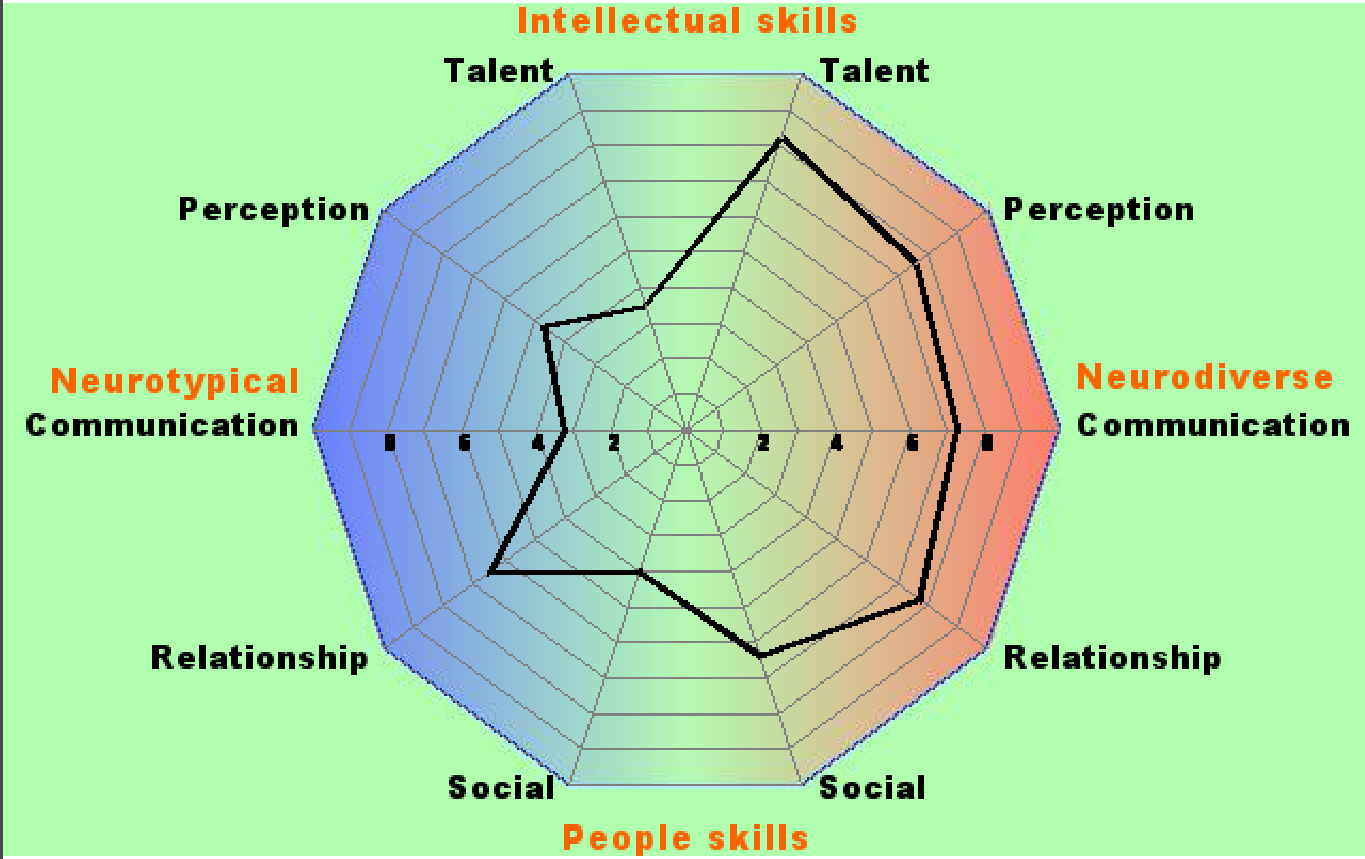
(The results from my Rdos Aspie Quiz.)
Alarmed by the prospect that I might be less self-aware than a character on HBO’s “Girls,” I found a psychologist in New York who specialized in autism spectrum disorders in adults. When he asked how I’d arrived at my suspicion, I explained that I had first believed myself to be a sociopath and rambled off my list of reasons. After some thought, he said, “Well, that’s not too uncommon. There’s a saying that people with Asperger’s can’t really see a forest when it’s in front of them, they just describe thousands of trees instead.”
Offended by his statement, I stumbled over my retort.
“Well, no. I mean if I’m walking in the woods I’m not going to be so oblivious as to not realize that I’m in a forest.”
He laughed on the other side of the line.
“Exactly,” he said, adding that I would likely benefit from coming in and exploring their services.
Thus began my life as a 32-year-old woman newly and neatly placed on the spectrum of high-functioning autism.
As I delved deeper, some of the most significant professional, academic and personal hardships of my life became legible to me. Additionally, my myriad quirks like my inability to tolerate fluffy towels and habit of walking on my tip-toes, my stubborn commitment to certain routes and routines, my eidetic memory, my love of collecting medical books and clinical trial data and my intense reactions to certain emotional and sensory stimuli finally had a context.
Yet for all the relief I felt in light of this revelation, there’s nothing that dulls your edge faster than the realization that not only are you NOT Dexter, but that you are, in fact, genetically unhip. Worse still? All those people you informed of your sociopathy mere months prior? Now you REALLY owed them an explanation.
And, just as I did that fateful day in middle school, I once again misgauged the anticipated reaction of my peers and family.
“Oh yeah, that makes sense!”
“That explains so much.”
“Duh.”
And “I’m so sorry, I wish we’d known about this when you were younger. I know your childhood was Hell.”
The words were spoken without hesitation. The humiliation, disbelief, confusion and lost relationships against which I’d steeled myself never came. Seemingly boundless acceptance and compassion did.
And while the jury is still out on whether I’ll ever be particularly cool, at least I’m confident.
