Showing posts with label Tumblr. Show all posts

Wednesday, November 1, 2023

Okay, I get it. But can we also...

 oneautisticperson, Okay, I get it. But can we also..., Tumblr

This day, the 1st November 2023 will be the last Autistics Speaking Day. This day started back in 2010 as a day for Autistic people to flood the internet with our messages and thoughts. While I have been very busy with my work, I thought I would contribute one last entry.


Okay, I get it.

Planning meals with me around is hard. I am so restricted in what I am able to eat and it is an annoyance. Good chance I can’t eat anything at that restaurant, I won’t eat anything from take-away shop etc. Guess what? It is an annoyance for me to. One of my workplaces has a work lunch coming up and I have to weigh up whether it is worth going. It is at a restaurant I have never been to and doesn’t seem to be located near places I know I can eat at so I can’t just get there early and grab something to eat somewhere else first. I would love not to have this problem. To not have to bring emergency food when I leave for a trip, to not have to eat beforehand when I go to most social gatherings.

But can we also…

Talk about the fact that when my best friend and I made pizza at her house for the first time, I nearly cried because I am rarely included in meals to that extent?

Mention the comfort that familiar foods bring me? If I am having a bad day, I know exactly what I need. It is not just eating the food but also the familiar smells.

Discuss that the same reason that makes food difficult for me brings me so much joy in other ways? My tolerance and enjoyment of show rides for example. Removing one would likely remove the other so I will take the good with the bad.

Okay, I get it.

I see you rolling your eyes when I try to talk about something that interests me. Show rides, neurodiversity, autism, Ned Kelly etc. You have heard me discuss this before and it is boring.

But can we also…

Mention that I have had to listen to you talk about basketball or other things a lot as well?

Discuss how great I feel when I find someone to discuss show rides, neurodiversity etc. with? Online groups in particular have been great with this.

Okay, I get it.

You find my tendency to withdraw rude. I spend too much time alone or with my cats.

But can we also…

Discuss that the noise is too much for me at times? Why must the tv, radio or Spotify always be on in the background? What is wrong with silence?

Discuss that my withdrawal also helps me socialise. It is a balance. I just don’t have the energy to socialise all the time. Withdrawing for a time means I get some recharge time and can socialise more afterwards.

Mention that being alone can be fun as well as beneficial?

Okay, I get.

You feel the need to tell me your perspective all the time.

But can we also…

Discuss my perspective. Discuss my strengths as well as my limitations. Discuss what makes me happy.

There has been attention on moving away from discussing deficits and instead discussing interests and strengths when working with autistic people. This needs to go beyond professionals and be common for families, friends and the wider community.

Monday, November 1, 2021

Autistics Speaking Day 2021: A challenge for Academics

 oneautisticperson posts Autistics Speaking Day 2021: A challenge for Academics on Tumblr.

Autistics Speaking Day 2021: A challenge for Academics

Well, it is the 1st of November 2021. Hence, Autistics Speaking Day 2021. A day in which autistic people (and some allies) all over the world will be posting blog posts, uploading videos and circulating other content about whatever we think is important. In some of my previous posts, I have challenged myself, disability service providers and teachers to do better in specific areas. This one is a challenge to academics, specifically academics that teach autism related university/college courses.

A colleague of mine in the disability sector is doing a Master of Education degree in Inclusive Education. Of particular interest, she did a topic specifically about autism spectrum earlier this year. She found the topic interesting and informative. This is great and I am not disputing that she gained a lot from the topic. However, we had conversations about it that I found ….. discouraging. For example, the topic did not mention neurodiversity, the neurodiversity paradigm or the neurodiversity movement at all. A problem in my opinion given these terms are so often discussed among autistic people both online and in person. Similarly, the topic made no mention of the double-empathy problem but did discuss theory of mind/autistic people having difficulty with theory of mind. Again, I see this as problematic given that the double-empathy problem is often discussed among autistic people.

At the same time this was going on, I had been asked to record a lecture for a new topic at the university I work for. The topic title included the term neurodiversity and the lecture I was asked to present introduced students to neurodiversity (and related terms) as well as autism spectrum. This topic had a medical textbook we were referring to (and critiquing) each week. It was so easy for me to critique the textbook! Like the topic my colleague was doing at another university, the textbook mentioned theory of mind but not the double-empathy problem and there was no mention of neurodiversity. In addition, the textbook went through potential causes of autism spectrum based on research but made no mention of the fact that a significant number of autistic individuals do not want the cause of autism to be found. Dates and symbols that are important to the autistic community, such as the rainbow infinity symbol and autistic pride day (18th June) were also missing.

Basically, what was missing from both the topic that my colleague did and the textbook used for my topic was autistic viewpoints and research. The double-empathy problem is something that autistic researcher Dr. Damian Milton, an autistic researcher proposed. Neurodiversity and the neurodiversity movement as phrases were thought up by Judy Singer, an autistic sociologist. That said, ideas regarding the neurodiversity paradigm and movement started much earlier and are thought to originate with Jim Sinclair, an autistic advocate. Recently, current definitions of neurodiversity and related terms come from a blog post by Dr. Nick Walker, an autistic researcher.

Why is this missing from university/college autism spectrum topics?

As mentioned above, because this is mainly discussed among autistic people and academics have largely not engaged with autistic people when designing autism spectrum topics. If they have engaged with autistic people, it is usually to give a one-off lecture about their personal perspective/experience. I do not deny that this is important (my students at the university say that it is) but we can go further. Autistic people around the world are writing/videoing about whatever we see as important today, some of those autistic people (along with other autistic people that have not contributed to this day) are willing to engage with universities/colleges, to bring the knowledge and perspectives that are currently missing. It is up to academics to engage with these people.

Why is it important for universities/colleges to include this content in autism spectrum topics?

There are many answers to this question but I will go with my favourite answer. For the students. This semester at the university I work for, I had postgraduate university students. Many of whom had some experience learning about autism spectrum before. Some of these students were learning about the double-empathy problem for the first time. Paraphrased versions of their comments include “very valid way of looking at it in my opinion” and “makes perfect sense.” Why should students miss out on certain perspectives like what is currently happening?

Another answer is for autistic people (and it seems fairly likely that students in an autism spectrum topic will end up working with autistic people). One student in my class just last week had a rant about the state of language used in research articles related to autism spectrum. She was annoyed that the language was very negative for most articles, the language being very deficit-based and terms such as “high-functioning autism” used. I was quite happy this occurred. It gives me hope that my students will not use such language in the future. That maybe the language used to discuss autistic people will change for the better.

The two reasons above are why I challenge academics to find autistic people that are willing to share knowledge/perspectives from the autistic community and researchers. To engage with these autistic people about what content should be included in autism spectrum topics that is currently missing. To include this content and invite autistic people to present said content.

We can do better. For autistic people and for our students.


I have another challenge for readers of this blog post that may not have heard some of the terms used in this blog post before. I challenge you to do some reading.

To read about:

The double-empathy problem (Milton, 2012): https://www.tandfonline.com/doi/abs/10.1080/09687599.2012.710008

The possible origins of the neurodiversity movement “don’t mourn for us” (Sinclair, 2012 [but first given in 1993]): http://www.larry-arnold.net/Autonomy/index.php/autonomy/article/view/AR1/html

Neurodiversity current terms and definitions (Walker, 2014): https://neuroqueer.com/neurodiversity-terms-and-definitions/

Thoughts from the person who coined neurodiversity “what is neurodiversity?” (Singer, n.d.): https://neurodiversity2.blogspot.com/p/what.html

Written by oneautisticperson aka Leeanne Marshall

Sunday, November 1, 2020

It Is Time

 Leeanne Marshall post Autistics Speaking Day 2020: It Is Time on The thoughts of One Autistic Person tumblr

Autistics Speaking Day 2020: It Is Time

It would be so easy to discuss the worldwide pandemic for my blog post. The impact it had (and continues to have) on me despite there being few cases of Covid-19 in my local area (the few cases are all in hotel quarantine). However, I think the world needs some positive news. Besides, it is time. Time for me to reflect and provide an update on my first two Autistics Speaking Day blogposts. To be honest, I have attempted to reflect and provide updates on these posts several times on previous Autistics Speaking Days but each time I either come up with an idea that is more relevant/important or I can not seem to find the right words on the day, leading me to write about something else. Not today though, I am determined to get this positive reflection/update Autistics Speaking Day post done.

Back in 2012, I wrote my first Autistics Speaking Day post here: https://oneautisticperson.tumblr.com/post/34749796115/autistics-speaking-day-on-communication

In this post, I mention that in the past, I had previously stayed silent on comments that I should have confronted. I challenged myself to speak up if/when these comments were brought up in future.

In 2013, I wrote my second Autistics Speaking Day post here: https://oneautisticperson.tumblr.com/post/65686842050/autistics-speaking-day-my-pathway

I mention in this post that I still needed to work on advocating (communicating) for myself. Another para graph I included was “I do not yet know if I can succeed in holding down a job typically for neurotypicals (a teacher). I am sure however, that whatever my career ends up being, it will be related to education in some way and will hopefully be around including Autistic individuals in general education settings.”

It is at this point that I once again start thinking about ditching this writing and starting over with another post. I am worried this comes across as bragging, however, I will persist despite my worries. I completed my teaching degree in the middle of 2014 but ultimately, I decided being a teacher was not for me. That said, my jobs, my advocacy volunteer work etc. have all been related to education and indeed, inclusion of Autistic individuals (and people with other disabilities) in mainstream school settings. For starters, I am a casual academic at a local university. I am involved in an autism topic as a guest lecturer, an assignment marker and (sometimes) a tutor. Students in this topic are usually enrolled in teaching, education or disability studies degrees. This means I am influencing current/future teachers and their attitudes towards Autistic people by my involvement in this topic. Importantly, last year I was paid to assist in writing the case studies used for one of the assignments to ensure the case studies seemed to be real, diverse and included a range of issues for Autistic people.

Since late 2018, I have been part of the Inclusive School Communities (ISC) project as both a member of the steering group and a mentor (young, disabled person) connecting with the project schools. This project is about making schools in South Australia more inclusive for students with disability. Earlier this year, I wrote a report for this project based on two focus group sessions at a South Australian high school. The report went through issues faced by students with disability at school and suggestions for what this school (and other schools) could do to work on these issues, as well as what the school was doing well. I included 9 recommendations at the end of the report for schools. If readers are interested, the report is publicly available here: https://inclusiveschoolcommunities.org.au/news/report-school-student-consultation

Through meeting each other in the ISC project, two other school mentors and I got involved in advocacy volunteer work. We have had discussions with a Ministerial adviser regarding what needs to be done to make schools more inclusive and to save a local high school that has been making a lot of changes to be more inclusive. I personally also spoke at a rally to save the school. I am pleased to report that the school was indeed saved, a win in 2020.

So, as you can see from the above information, I have indeed been involved in the inclusive education space (just not as a teacher). As to the other problem I had, well, I am no longer silent when I should be speaking up. In fact, I sometimes worry that I dominate meetings with the other mentors in the ISC project (though they assure me that while I speak a lot, I do not dominate). Overall, I have certainly come along way since 2012-2013. Just goes to show how much personal growth and experiences can happen in 7/8 years. I have certainly done what I challenged myself to do in 2012 and what I wanted to do in 2013. I believe my efforts will help other Autistic people (and other people with disability).

……To my readers, I think now it is time for you to do some reflection. In what ways do you make the world a better place? For your local community, for your friends/family and/or for yourselves?

Thursday, November 1, 2018

#AutisticsSpeakingDay2018 Post: A Call to Intertwine Race into the Autistic Community

Timotheus "T.J." Gordon, Jr., #AutisticsSpeakingDay2018 Post: A Call to Intertwine Race into the Autistic Community on The Black Autist


#AutisticsSpeakingDay2018 Post: A Call to Intertwine Race into the Autistic Community

Happy Autistic Speaking Day everyone! 

If we ever going to have an inclusive and vibrant autistic culture, then we must accept and recognize the diversity within the global autistic community. Autistic everywhere must understand that only the autistic experience varies from person to person. The autistic people themselves don’t all fit the mold of Sheldon Cooper or Raymond Babbitt; they have diverse backgrounds. 
Yes, there are people of color in the autistic union! Admit it. Accept it. Embrace it even. Our community can’t no longer ignore autistic people of color just because they look different or may not share STEM interests. 

I’m seeing more autistic people of color share their stories and paint a portrait of a spectrum of experiences within the autistic community. I appreciate them redefining to mainstream folks how autism manifests in daily life; they are chiseling away the single narrative of what it’s like to be autistic by adding intersecting/interlocking identities into the narratives. Personally, it’s been a privileged working with my autistic people of color in promoting autistic acceptance in communities of color and expanding narratives of autistic people beyond the typical ones from white autistics. 

Yet, there are still some autistic people in social media who are expressing the call to end slipping intersectionality into autistic culture. From what I got from social media responses, some may not understand or want to recognize how race and autism are tied together, or why people bring up race and autism in the first place. Perhaps they might want an autistic community where every autistic are bound to a specific set to cultural norms and expectations, including subjects that are highly interesting to them (stereo-typically, it’s STEM fields or recalling facts). 

In fact, there have been people expressing desires for the autistic community to be defined as a race of people or an ethnic minority; they use those terms to describe how we have been marginalized by an ableist, capitalist society. They also illustrated how autistic people are bound by shared characteristics and interests, such as stimming and special interests related to geekery. 
I concede that autistic people are marginalized people based on discrimination and harassment we face at home, school, institutions, workplace, and leisure spaces. We are marginalized based on limited access to explore healthy sexualities, viable job and career options of our own choosing, autistic-friendly housing, starting families, and overall health care. 
However, autistic people are not a race or ethnic minority. In order to be an ethnic group or race, the people must share similar customs and beliefs, geographical areas, and have similar physical traits. 

For those who want autistic to be a race or ethnic minority…most of the people who are wishing for it have been identified as white. So if I translate this correctly, their perfect autistic community consists of white autistic people. But, I thought autism doesn’t discriminate based on race and ethnicity, religion, sex, gender, sexual orientation, etc. If you want an united autistic people community, then recognize that people of color, like myself, can also be autistic; enough with the erasure of autistic people of color in the mainstream autistic community. 

Also, we are all over the world’ we don’t originate in one particular place or “motherland”. 

Last, a race or an ethnicity is defined by similarities in belief systems, culture, food, clothing, etc. Just as the physical representation of autistic people is diverse, the cultural aspect of the autistic community is vast and variable as well. From what I’ve seen and what I’ve read in social media, the autistic culture within our community is formulated through what supporters of the autistic race think what the autistic community should be. And it’s often the white cis-male perspective of the autistic community that is promoted more regularly. The STEM interests, the trains, the D&D. Which I do like, don’t get me wrong. But there are autistic people (especially some autistic people of color) who have special interests and intense fandom beyond the conventional geek world. Some may be more into sports, dance, fashion, cooking, kinky stuff, etc. 

In short, if we, autistic people, continue to uphold a narrow view of what the autistic experience look like and not allow for inclusion and diversity in the autistic community, then the autistic community will continue to be labeled “too white” (and I dare to even say “too cis-male and scientific”). For starters, it would be lovely if we include more discussions of race and autism into our community and encourage more autistic people of color to build their own safe spaces and/or be welcomed into mainstream autistic community. Autistic folks, myself included, must expand beyond the Sheldon Cooper or Temple Grandin stereotype. 

Autistics Speaking Day 2018

Leeanne Marshall, Autistics Speaking Day 2018 on oneautisticperson Tumblr.

Autistics Speaking Day 2018

It is currently the 1st November, 2018 meaning it is once again Autistics Speaking Day and time for my yearly blog post. Last week, I thought I would not get around to writing anything. I was out of energy and strangely, feeling disconnected. A week later after plenty of thinking (mainly while having long, relaxing baths), I am feeling okay enough to attempt to write something. This post is not a challenge to anyone (as some of my other autistics speaking day posts have been). It is a post for me to look back on next year should I feel the need to. Hopefully others will find it valuable as well.
Transitions. Transitions can be hard for autistic people and I am no exception. When I left secondary school and started university, I went from a small secondary school to a much larger place. I remember thinking I was going to faint in some of the lecture theatres, hiding under random staircases around university to get away from people and telling my disability advisor I would not do my study part-time because I hated university and wanted to leave as soon as possible. I was convinced I did not belong at university and would always hate it. That first meeting with my disability advisor was awkward in other ways to. She asked me what I thought I needed on my disability access plan and I responded that I did not know. I relied on the disability advisor at university to tell me what I would likely need, though I did say no to several suggestions.
I finished my first university degree and started a second one. For the career I had planned on, this was necessary. Despite my second degree taking place at the same university, I again hated the first few months and felt I did not belong. I completed the second degree but realised I needed a new career pathway. I ended up going into a third degree in disability studies, again at the same university. Once again the first few months of the degree was hard (though this time it was made easier by me frequently talking to my lecturers from previous degrees). I also started a casual job for the first time during this degree which caused anxiety. One of lecturers offered to let me go home from class due to how pale I looked. Ultimately though, I am finding the degree valuable (the only part of university I really dislike is writing assessments, research is fine) and I enjoyed the casual job. Once I got through the first few months of major transitions, I was fine.
What does this tell me? Above all, since my university study is taking a different direction next year and because I am soon taking up more casual work, this post is to remind myself that although I will likely struggle with the changes in the beginning, I will most likely be okay. This is also a reminder that focus on transition for autistic people is important and therefore my study direction is important.
…..also, Intellectual property and recognition of work are terms that have repeatedly come up in my life this year. As such, I think it is time I put my real name to my blog entries. This post and all previous posts on this blog have been written by Leeanne Marshall aka oneautisticperson (of many autistic people).

Here’s the Thing About Language

Autisticeducator, Here’s the Thing About Language on Tumblr

Here's the Thing About Language


You can change labels of what you call people all you want “to be more people friendly” or whatever reason you claim to have.
But…
If you don’t change the social constructs behind the language, the factors limiting the group that is actually directly affected by the language, then changing the language becomes rather pointless because it doesn’t actually change any of the social issues behind it.
Take people first language (yes, I’m going to continuously be picking on people first language because it does such a good job at getting my point across). The abled bodied population was like “This sounds good, let’s use it for the entire disabled community.”
Yeah, except the autistics have been shouting “Um excuse me, but people first language dehumanizes us because it separates us from our identity. We want identity first language.”
And if those advocating for people first language (especially abled bodied parents and those in education) had ever stopped to deal with the social constructs that affect the autistic community instead of pushing on their language crusade, I wouldn’t be writing this post right now. But they didn’t.
And people first language is not harmless like they want to believe. I’ve personally had people first language used against me numerous times by people who did not want to acknowledge that I am autistic. People first makes it easier for people to deny us either our needs or our agency (or both) by allowing them to think “Oh they’re a person and I can just push this autism bit off to the side and ignore its exsistance.”
That’s why I am insistent on identity first language. I want to make it difficult to separate autism from myself because they are not separate entities. They are the same entity because I see and experience everything through an autistic lens. People who aren’t going to see me as a person won’t see me as one regardless of language used. It’s those who only want to see me as a person if autism isn’t coming along for the ride that I find really problematic.

Wednesday, November 1, 2017

Neurodiversity Theory: An Introduction

Leonard Corey Philip has submitted his final paper for his B.A.


**Please note, the following submission has not been completely vetted for content. It is a 20-page academic paper on philosophy, ableism, disability, and neurodiversity. 


Neurodiversity Theory: An Introduction [PDF] 

Autistics Speaking Day: On Understandings

Leeanne Marshall Autistics Speaking Day: On Understandings from oneautisticperson


So, it is the 1st November 2017, meaning it is Autistics Speaking Day 2017. The following is my blog post on understandings from an Autistic perspective. I hope people enjoy reading.

I am 6 years old.
I am 6 years old and I am in music lesson with the rest of my class. A person in my class has answered “pig” to a question and it is clearly the wrong answer. I do not find this funny but because the rest of my class is laughing I laugh as well. The music teacher then tells me off for picking on another student. I go quiet and decide to never speak in that class again. 
I am 6 years old and I understand that my music teacher is unfairly picking on me.

I am 8 years old.
I am 8 years old and in my classroom after lunch on Friday. As usual, I am writing down everything on the blackboard that I had not managed to finish writing during the week. Four other students are also writing down everything they had not finished writing during the week, it is always us. The rest of the students who have finished writing are enjoying free time, doing whatever they want.
I am 8 years old and I understand that I am being punished for not being able to write at the same pace as most students.

I am 13 years old.
I am 13 years old and have written a story in my English book. Like everyone in my class, I now must type up that story in a word document. I type much slower than most of my class, it is not on purpose I am just slow. Most of the class now have free time on the computer while a few of us are still typing. One of my peers has noticed how little progress I have made and offers to help. Our teacher stops her from helping.
I am 13 years old and I understand my teacher wants me to struggle.

I am 15 years old.
I am 15 years old and am in a compulsory Home Economics class. Once again, I do not see the point taking this class because I am not going to eat what we have been forced to cook. Once again, the group I am assigned to has just made me wash dishes to get me out of the way and I do not mind. Once again, the rest of my class seems to be enjoying the practical cooking lesson.
I am 15 years old and I understand that I am different from my peers since I am the only person consistently not eating the cooked food and the only person that is happy to just wash dishes.

I am 16 years old.
I am 16 years old and just got out of my first photography class. I am meant to be taking the photography class as an elective for the semester, but I have encountered a problem. The smell of the photography classroom is bad and I spent the entire lesson concentrating on continuing to breathe. I did not hear one word of what the teacher said and I do not recall the name of the teacher. I make an appointment to see the school counsellor as soon as possible to enrol in a different topic.
I am 16 years old and I still understand I am different since I was the only person affected by the photography classroom smell.

I am 18 years old.
I am 18 years old and just got back from a follow-up appointment with a neuro-psychologist. The neuro-psychologist told me that I have Asperger syndrome. I immediately start looking up information about Asperger syndrome. I learn about sensory issues and social issues.
I am 18 years old and I understand why I am different.

I am 23 years old.
I am 23 years old and am completing a teaching degree. In the teaching degree, we are learning about ways to make sure students have completed tasks. It occurs to me that my grade 3 teacher was probably not punishing me for not being able to write as fast as other students. It was probably her method of ensuring I had the necessary information and completed the necessary tasks.
I am 23 years old and I understand that some of my past understandings have been wrong.

I am 27 years old.
I am 27 years old and I am writing a post for Autistics Speaking Day 2017. As I am writing it, it occurs to me that some of my present understandings are still likely to be wrong.
I am 27 years old and I understand that my understandings may change.

The reason I have written this post for Autistics Speaking Day is largely because, in the past, I have not understood the intentions of my teachers. This is not my fault since it is hard to know the intentions of people when people are not making it clear what their intentions are. If any teachers of Autistic students are reading this, my message to you is that I hope you are making it clear why certain things in your classroom are happening ……. so less misunderstandings occur.
The same goes for anyone who works with Autistic people in other contexts.

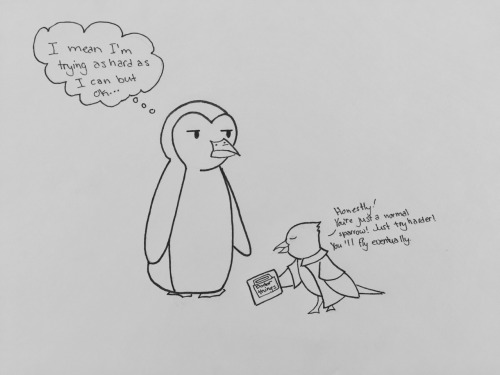
Sparrows and Penguins

An Anonymous Guest on Samantha Hack's Candidly Autistic has submitted Sparrows and Penguins


Imagine that you’re a sparrow, living in a family of sparrows in a town of sparrows in a world of sparrows.

But you’re kind of a shitty sparrow. Kind of the worst sparrow, actually.
You can’t fly. You’ve been to doctors who have prescribed medicine to help with flying. But you still can’t. You try every day, and every day you fail and this thing which all the other sparrows tell you is critical.

For a while, you stop trying. Failing every day just wore you down and you couldn’t do it anymore, so you stopped trying to fly. It was nice in some ways, but you felt guilty because you weren’t raised to give up. It made a rift with your family. Flying is an important activity that sparrow families do together. Isn’t your family important to you? Don’t they deserve for you to at least make the effort?

So since it’s nothing medically wrong with you, you go to a therapist, who diagnoses you with a phobia of flying. You work on overcoming your fear. You’re lucky, your family is very accepting of mental illness (other sparrows are not so lucky, and it hurts your heart to think about that). They appreciate and admire how hard you’re working. They try to include you, so instead of getting together and flying, sometimes they get together and all sit in their nests. That sort of sucks too, but it’s a definite improvement.

You continue to try, and fail, to fly. You try harder. You try as hard as you can. Sometimes you can’t even make yourself flap your wings, it’s just such pointless bullshit and you feel like you’ll never succeed. Sometimes you go up on a chair and jump off and flap real hard and go splat anyway.

Sometimes mean birds make fun of you because you’re a terrible screw-up.
For 26 years, this is what your life is.

One day, almost out of nowhere, as an afterthought, an aside, something barely worth mentioning because it is so obvious, a doctor says, “by the way, you’re a penguin.”

Holy shit. You’re not a failure. You’re a penguin. You’re not lazy or stupid or weak. You don’t have messed up values. You’re a penguin. You have always been a penguin.

There’s nothing wrong with you, you’re a beautiful penguin. The most perfect penguin. But it’s just a fact, penguins can’t fly.

Now when you’re with you’re sparrow friends and they’re all sitting in nests, you sit in a bucket of ice. Mostly you bring your own. Some bird restaurants are really accommodating and will bring you a bucket of ice to sit in. Sometimes mean birds give you shit about your bucket, but it doesn’t hurt as much as it did before, because you know you’re a penguin and you’re just exactly what a penguin is meant to be.

You give yourself permission to stop trying to fly. Not failing all the time improves your mood and overall function. You finally feel confident declining when invited to flying outings. You don’t waste the energy feeling guilty about it.

You love your family of sparrows, but you also find a whole community of penguins to love too. Things you thought were just you, like preferring fish to bird seed, things you thought you were totally alone in and wrong for, are common and accepted. Some are even admired. Your new penguin friends think your flippers and chubby penguin belly are lovely. You bond over how and when you discovered you loved swimming.

Knowing you’re a penguin means knowing where you fit in a world you never felt like you fit into. It means all the things penguins can’t do, it’s not a personal failing when you can’t do them. You’re not supposed to be able to. You can do other things instead. Sparrows are actually quite poor swimmers. You feel good about the things you excel at.

This is why I think labels are important. This is why I think “we’re all birds, let’s focus on our similarities instead of our differences” is harmful. This is how my autism diagnosis was like breathing, after holding my breath for 26 years.

Tuesday, November 1, 2016

Autistics Speaking Day 2016: An Unplanned Entry

Leeanne Marshall writes "Autistics Speaking Day 2016: An Unplanned Entry" on The thoughts of One Autistic Person.


Today, the 1st November is Autistics Speaking Day (ASDay) 2016. In the lead-up to today I have been reading through my blog posts for previous years. So many thoughts seemingly swirling through my mind making it hard to focus on, and write about, one thought.

I actually wrote the above paragraph on the 31st of October. I was trying to write the post that day since I knew today was going to be busy for me. However, I was not able to focus my thoughts and get this entry written. Perhaps this has ended up being positive since I had an experience at university today that I think is worthy of a post on its own.

To acknowledge ASDay I cosplayed as the character Yugi from the manga and television series Yu-Gi-Oh! to my university class today. The reason I did this was because I have been a participant at the Yu-Gi-Oh! The Trading Card Game Australian Nationals, so I thought cosplaying as the main character from Yu-Gi-Oh! was fitting. I also happen to know that many Autistic people like Yu-Gi-Oh! I have found many of my Autistic friends through participating at Yu-Gi-Oh! Tournaments.

As I had hoped, the Yugi costume and my reasons for wearing it came up in conversation during class, allowing me to explain ASDay to my lecturer and other students (the course I am undertaking is in disability studies so it is useful for my classmates to know). Another Autistic individual in the class mentioned that her Autistic son also likes Yu-Gi-Oh! so she should introduce us to each other at some stage. I told this person and the rest of class that I found a significant number of my Autistic friends through playing Yu-Gi-Oh! even though most of us did not have a diagnosis of autism spectrum disorder at the time, we got a diagnosis later.

I did not anticipate someone in the room questioning why I felt the need to mention that a significant number of friends I made playing Yu-Gi-Oh! were Autistic. To me it seemed obvious, I mentioned it because it was fact and because a lot of Autistic individuals do seem to like Yu-Gi-Oh!. His argument was that it did not matter whether those friends were Autistic, Neurotypical (a person whose brain is wired the usual way) or a different form of Neurodiverse person (a person with dyslexia, ADHD etc.).

To me this does matter. While I appreciate my Neurotypical and other Neurodiverse friends, I have found a true sense of belonging in the Autistic community. Just over the weekend, I was struggling with a certain issue that lots of Autistic people struggle with. I was able to vent about the issue to a Facebook group of all Autistic individuals, some of whom I have met in real life and are my friends. They understood my issue, gave examples of facing similar issues and made me feel like I was not alone.

That said I get where this person in my class is coming from. In the past, people with disabilities were often segregated from other people and from what I understand, did not have much opportunity to make friends with people without disabilities. Even now, exclusion of individuals with disabilities from the mainstream is an issue (and one that gets frequently talked about in our disability studies classes). I certainly think Autistic individuals should have the opportunity to find Neurotypical and other Neurodiverse friends ….. I just also think that being able to make friends with other Autistic individuals and feeling that sense of belonging to a group is important as well.

This is not the ASDay post I intended to write but I think it is a valuable post all the same. Perhaps next year I should also make an effort to cosplay as a character for ASDay and see what happens.

Sunday, November 1, 2015

‘Nothing about us without us’ except….

Leeanne Marshall "‘Nothing about us without us’ except…." from oneautisticperson


“This is a unique situation” “I am in charge and I am autistic so that is not needed” “That only applies in certain situations … this is not one of them” “This is a different kind of decision”
These are all statements or similar to statements I have heard recently from people who have authority over autistic individuals in various services. The people in authority state their agreement to the Autistic Self-Advocacy Network tag line ‘nothing about us without us’ but come up with an excuse as to why they do not have to follow that statement in specific situations. Some of these people will even tell other people in authority over autistic individuals that they must listen to their clients. I am sure some even think that they do listen to autistic people and value what we have to say because they do listen ….. in certain situations ….. when the person in authority thinks it is necessary or, to be blunt, when it suits the person in authority to listen.
I have reasons for not wanting to go into detail about the situation that happened recently. That said, the reason I am writing this for autistics speaking day 2015 is that not being listened to when accessing disability services is sadly, very frequent. A few years ago I was part of a social group for autistic women. I hope I am never again part of a group where the person in charge has chosen bowling for an activity and only 4 people actually participated in bowling while the rest of sat and talked at a table because we did not want to go bowling (and of those 4 people, only 2 were clients). I hope I am never again part of a group where we are told we can make our owns rules, because we should have some ownership of the group, but our rules will only apply to certain people and will not be considered to be as important as rules set by the person in charge. I hope I am never again in a social group that ends up being suspended because some of the clients felt so angry about not being listened to that they walked out of the group one session and meetings the following few weeks. That said, I do not regret walking out and would do it again if faced with the same scenario …. But this could all have been prevented if we were listened to and had a say in decisions that affected us.
When autistic people are only given a voice on some issues and decisions that affect us when accessing a service, it means that ‘nothing about us, without us’ is not being fully adhered to. It is a token voice and it gives the person in authority too much power. The person in authority comes with his/her own biases of what they think the service should be like and how the service should be presented (in the case above, the person in authority seemed to enjoy bowling and selected bowling as an activity regardless of the enjoyment of the clients). The person in authority needs to remember that the service is there for autistic clients and the clients should have a say about the service. That does not mean that every suggestion made by the clients should be followed (each autistic person is different after all, and so each client will have different ideas on what the service should be like) but it does mean the clients should always be consulted and have the opportunity to speak or communicate their thoughts in other ways. It also means the person in authority should take time to seriously think about the suggestions being made and not just instantly dismiss them.
The bottom line is when it comes the motto ‘nothing about us, without us’ it needs to be more than just words. If you are reading this and you in charge of a service for autistic individuals then you should be ensuring your clients involved in that service get a say in every decision that affects them. If you find yourself even now coming up with reasons why that can’t happen then I think you are actually making excuses and I challenge you to change your attitude. This does not mean that you have to go along with every suggestion made by the autistic people you run the service for, there may be reasons why you can not go along with these suggestions but you should listen and be able to thoroughly explain your reasons if you do not follow suggestions. ‘Nothing about us, without us’ no exceptions.

Building Hope

Kit Mead from k-pagination (tumblr) and Paginated Thoughts has sent in the following piece!


Building Hope


My first experience with neurodiversity was something built gradually from the ground up. It built itself around social connections first, and someone driving me to a public lecture on autism and neurodiversity. Gradually reaching out and pulling together a community. It was the beginnings of what would be the disability student group on campus and my ASAN chapter.

It was a revelation, to say the least. I learned about an entire culture (http://iamthethunder.tumblr.com/post/82856793894/autistic-culture). I myself fell into it hard and fast but the community took a while to build locally.

I am proud of what everyone involved in all that has accomplished.

***

The Internet has always been my second home. I started an “autism blog” in 2013. I had been on Tumblr before, but not knowing about neurodiversity and mostly reblogging things like cats.

Autistics have a lot of pain to work through, which I have seen flashing up all around me. We have a lot of trauma and ours is the history of a group maltreated. Having pain to work through is fine.

We do have a community, diverse among its interests and identities. We have more people discovering how their brains work every day. It is important to cultivate a disability identity in people carefully and with kindness. Autistics have a lot of pain to work through.

***

Autism is a neurotype, not a political belief system or other set of beliefs. We share a neurotype. We are diverse. We have pain. We have different opinions. I've seen us come together on a lot of issues and part on others, recent though my addition to the neurodiversity movement is.

***

The reason I joined neurodiversity was because someone found me and realized that I could contribute something. They helped me learn, slowly, to create an identity out of disability. I read everything I could get my hands on. I came into neurodiversity when the community was speaking out even louder than ever against groups like Autism Speaks. I embraced it.

I was fortunate. I managed to pick up what words to use and had some talent with writing that lent itself well to blogging. I had someone patient to teach me. I joined neurodiversity because someone helped bring me into it. I have hopes for this community. In some areas, I fear for it. The splits seem wide in many areas.

***

There are many types of advocacy and activism.

For instance: resistance can be self-advocacy. Self-advocacy can be resistance.

If you write just one blog post, you have contributed. If you're not on the front lines and doing spitfire activism, and are quieter in the background, you have contributed.

Some people would argue that “quiet activists” do no good, but I disagree (http://k-pagination.tumblr.com/post/128704249984/activist-burnout).

We have room for all kinds of activists and advocates in this community. Some are newer, and perhaps we could learn to handle each other more gently.

Saturday, October 31, 2015

Representation (2014)

Louise sent in this entry for ASDay 2014, from Tumblr blog MindTheLSpace

Representation 

I’m currently reading some reviews for a book containing a character with Aspergers. I haven’t actually read this book, so I don’t know whether it’s any good, what the portrayal of the autistic character is like etc, but nonetheless, some of the patterns in the negative reviews are troubling me. 
One, that the main plot of the book centred around a divorcee looking for a new partner, with the ‘son with Aspergers’ plot being secondary. Some reviewers seem very surprised that this is the case, and several saw it as a negative. This is despite the fact that the author specialises in romance, and the blurb isn’t in any way misleading about what the central plot is. 
Two, that the book is written in a very light-hearted, jokey tone. Several people are claiming that this is 'inappropriate’ of otherwise 'weird’ for a book where one of the main characters is autistic. 
Three, a handful of reviewers complained that the book didn’t give enough 'insight’ into what it’s like to raise an autistic child. 
So basically, if a book contains a prominent character on the autistic spectrum, the book must be: 
1) Entirely about the ASD. More specifically, about the negative effects ASD has on both the individual and the individual’s family. 
2) Written in a serious tone, because autistic people can’t be written about in a light-hearted way. 
3) A substitute textbook with something to teach non-autistic readers. 
To strip that down:
1) Autistic characters can’t be incidentally autistic, or 'just there’. 
2) ASD is always sad, and serious, and difficult. There’s never anything to be light-hearted about. 
3) Autistic characters should serve an educational purpose. They can’t just be there in their own right. 
So, to extrapolate (some of you may say extrapolating a bit too far, which is fair enough.): 
1) Autistic characters can’t be standard characters. They’re the exception. A point has to be made of them. 
2) Autism is a tragedy. A perpetual tragedy for both the autistic person and everyone who spends more than five minutes around them. This puts us straight into the 'Disability as a tragedy’ narrative, which is a huge, huge issue, and one most disability campaigners want to get rid of. 
3) Disabled people exist only in relation to non-disabled people. Again, this is a very old and very fucked up narrative, which most campaigners would like to see consigned to history. 
I’m not for a single second suggesting that all these reviewers were actively thinking “How dare the author make jokes, disabled people are tragic and terrible!” as they wrote down their thoughts. What they were probably doing, however, was writing down the expectations and subconscious beliefs that the world around them had, in numerous subtle ways, encouraged them to have. Ideas about disabled people being 'other’ in a negative way. 
I find the ideas presented above very damaging. Because to ourselves, we’re notthe other, but that’s the only way we ever get to see ourselves portrayed in the public eye. Our lives, generally speaking, contain positive and neutral emotions as well as negative ones, so it’s strange for us to think of our entire beings as something that has to be written about in a death-bed tone. And thinking of ourselves as tokens or vehicles, existing purely to educate non-disabled people, is faintly disturbing. 
Disability discourse needs to change, and representation of people like us, as opposed to representation of Our Condition 101, is so, so important. 
(This is the book in question, along with the reviews I’m reading, if anyone’s curious) 

Autistics Speaking Day? (2014)

Liese sent in this submission for ASDay 2014, on her Tumblr Waking Up to Live.


Trigger Warning for mentions of bullying, social pressures, self-taught "quiet hands".


Autistics Speaking Day?


Sunday, November 2, 2014

Hope Says 'Yes'

R. Larkin Taylor-Parker writes "Hope Says 'Yes'" on Traveling Show tumblr

Even with open memo breathing down my neck, Autistics Speaking Day is too important to be all reruns.  Forever ago, when it was warm out and I had time on my hands, I wrote about how I saw us facing a decision: we could be a flashover subculture, mostly small bands of Internet rebels, or we could be something lasting, ultimately a people.  The signs as I read them say that enough of us are making the moment-by-moment commitment to each other that I hoped we would.   
One of our own who needs help has gotten a lot of support.  I said we needed more room for dissent and different styles and watched the new follower emails arrived.  we laugh at some of the same things.  The agenda is more than ‘no.’  There are still things to say no to, like eugenic ideas as resilient as fictional monsters and whatever those presidential aides thought they were doing.  Community, society, and culture, though, are more than resistance to whatever is imposed, oppressive, unwanted, or wrong.  The latter is a necessary condition for the former in the long run.  Increasingly, I see people saying ‘yes’ to student groups, writing and disseminating good ideas, writing their elected officials, or chipping in a few dollars toward something worthwhile.  The dream that absorbed so much of so many of our lives was worth it.
I said that a culture is a story.  We won ours somewhere along the way.  Make it a good one.  Between now and this time next year, say ‘no’ when other autistics need you if you can.  Also see if you can say ‘yes’ to something that makes it better, richer, more welcoming than before.  What you do can be as small as including someone or as big as starting a business or nonprofit.  Whatever your gifts, abilities, and circumstances, your contribution is very important.  You can help this thrive and grow.

Saturday, November 1, 2014

Autistic Pride and What You Need to Know

Kit Mead posts "Autistic Pride and What You Need to Know" on Pagination Imagination tumblr and Paginated Thoughts blog

[TW: Includes links to the abuse of Autistic people and violence against them, as well as "quiet hands" and seclusion.]

Autistics Speaking

Our methods of communication may not be what you are accustomed to. Sometimes we use assistive technology or just flapping intermingled with words to get the point across. But we all have things to say. Listen.

To all my fellow autistic people


Kristin Guin writes on tumblr:


To all my fellow autistic people who believe in God: You are loved fully and completely by God. Your autism is not something God has given you to overcome to prove His power. God does not need His power to be proved by His children overcoming God-given integral, inseparable parts of ourselves. God proves his power by the depth and breadth of the love of ourselves and others because, if we love ourselves, that means we are proud of ourselves, and pride in ourselves is empowering. God made you autistic because He recognizes the beauty and necessity of neurodiversity among His children.

I'm Tired

Becca has written "I'm Tired"


As an autistic person, a lot of what I see in the world makes me angry. The talks of erasing 
us, the Kelli Stapletons, the constant speaking over the top of our voices. The world calls us 
violent, yet what I see whenever I open my eyes is angering and, yes, incites me to want to 
be violent.

But mostly, I am tired.

I’m tired, because no matter how loudly we shout or how well we explain ourselves, no one 
listens.

I’m tired, because the world only wants to tell us that we are wrong and we can’t possible 
know ourselves better than them.

I’m tired, because all I hear from my autistic friends is the same angry story, halfway 
towards giving up on it all.

I’m tired, because I can’t risk speaking who I am, so I have been forced to be someone I 
cannot be.

I’m tired, because there’s nothing I can do without stepping into a place that was designed 
to be uncomfortable for me at best, deadly at worst.

I’m tired, because when they do acknowledge us, they paint a picture of us that we are not.

I’m tired, because the only time they care about us is to make themselves feel better, 
meanwhile continuing to disregard our realities.

I’m tired, because I have to make up lies to protect myself from a world that wants me dead.

I’m tired, because no one is willing to see that I am me, that I am not something buried 
under what they see as a disease.

I’m tired, because whenever I speak up, my voice is too quiet, too easily drowned out.

I’m tired.

How can I fight for my very life when I’m so tired?