Friday, November 1, 2013

My Fingers Speak

Amy Sequenzia writes "My Fingers Speak" on Non-Speaking Autistic Speaking


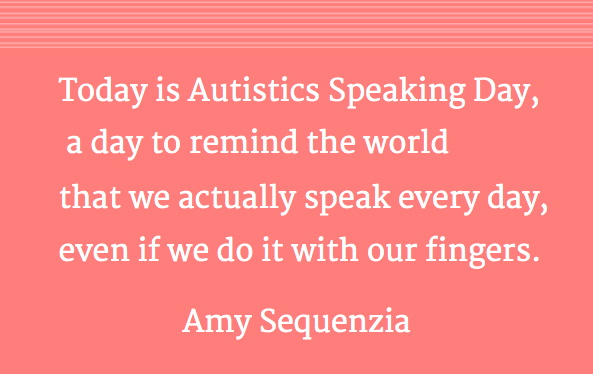
Today is Autistics Speaking Day, a day to remind the world that we actually speak every day, even if we do it with our fingers.
 Today is Autistics Speaking Day,  a day to remind the world that we actually speak every day,  even if we do it with our fingers. Amy Sequenzia
My voice is unique
It does not come out in a usual manner
I speak through my fingers
Gentle strokes on a keyboard
I could have remained silent
I could have chosen a passive life
But my fingers would not accept a quiet existence
So I type my thoughts
I fight for autism rights
My brain and a keyboard
My thoughts awaiting
Restless fingers demanding to be heard
Flowing words, my manifesto
My fingers will not accept a quiet existence
Silent no more
My voice through my fingers
I will not accept to be ignored
Listen to what I have to say
We are here, here to stay
We find ways to scream our words
MY FINGERS DO NOT ACCEPT A QUIET EXISTENCE
Amy Sequenzia is an Autistic activist, writer, and poet. Read more on Ollibean here , on her blog at Non-Speaking Autistic Speaking and on Autism Women’s Network.

Isolation, Loneliness, and the Angry Aspie

Nicole Nicholson writes "Isolation, Loneliness, and the Angry Aspie" on Woman With Asperger's.  Subject warning for negative events and feelings, some mental health issues, isolation.


While I have always tried to be truthful and revelatory when writing posts for this blog, in this post I am probably speaking with the most candor, bluntness, and with the rawest language I have used in a long time. I don’t see the need for a trigger warning, except that I am speaking about negative events and feelings I have been keeping private for a long time. Also, I will be using more profanity that my readers are used to seeing here on WWA. If that doesn’t scare you, read on. I should warn you that some of this may not read very cohesively and might seem like a very long rant, but I have had a need for a long time to say some of these things.


Autistic as a Reclaimed Word

Cynthia Kim posts "Autistic as a Reclaimed Word" on Musings of an Aspie

Most adults on the spectrum prefer to be called autistic, rather than a person with autism or a person who has autism. The general consensus is that autism is not a separable entity. To be “with” something or to “have” something implies that we might somehow be able to rid ourselves of that thing and still be the same person, much like someone who has been cured of a physical illness.
I have always been autistic and always will be. If I was not autistic, I would be a completely different person. My autistic neurology affects how I experience the world and how the world experiences me. I am autistic. This feels very simple and logical to me.
It is not, however, always as simple for others. I’ve noticed that a lot of people in the autism community (which is different from the Autistic community) find the use of autistic as a label offensive or at least uncomfortable. The primary argument is that “autism doesn’t define” the person that they are reluctant to call autistic (often a family member).
Inherent in that argument is the belief that autism is a negative attribute. Why else would someone be averse to being “defined” by a trait? Would we say, “don’t call Tommy intelligent because his intelligence doesn’t define him” or “don’t call Katie blue-eyed because her eye color doesn’t define her.” 
Positive or neutral labels are rarely challenged. Smart. Beautiful. Man. Woman. Right-handed. Left-handed. Blonde. Brunette. Few people will object if you refer to yourself or someone else by these labels. No one will tell you to call yourself a person with beauty or a person who has right-handedness.
So why the controversy over autistic? Perhaps because autism still carries so many negative connotations. We are in the processing of reclaiming autism and autistic, but we’re not quite there yet.

LINGUISTIC RECLAMATION

Reclaiming (or reappropriation) is the act of taking back a word that has been used as a pejorative. When a group adopts the use of a word that has been used to demean them, they diminish or subvert the power of that word as a weapon.
Queer and gay are words that many people consider to have been successfully reclaimed. Gay, once used primarily as an insult, has become a preferred label. Queer is still in the process of being reclaimed, but well on its way. Geek and nerd, insults a generation ago, are now common self-descriptors.
I find it interesting that there is so little discussion of autistic as a reclaimed word. It certainly fits the definition.
Autistic has been and is still used in a derogatory way. It could even be argued that it’s “the new R word.” That’s so autistic and are you autistic? have become common put downs in certain gaming and internet circles.
To be reclaimed, a word first must have been used in a way that is derogatory to the group it describes. Autistic, then, is ripe for reclaiming. And I would argue that not only does it need to be reclaimed to take away its power as a slur, it needs to be reclaimed by autistic adults with the goal of redefining it in the public’s imagination.
Even before it became an outright slur, autistic (and autism) had negative connotations. For many people, autistic conjures up the negative, doom and gloom stereotypes of ASD and little more. By reclaiming autistic, by using it as a symbol of identity and pride, we can broaden public perception of what it means to be autistic.

Autistics Speaking Day 2013

From Sparrow Rose Jones on Unstrange Mind comes Autistics Speaking Day 2013.

“If you know your history,
Then you would know where you coming from,Autistics Speaking Day 2013 Participation Badge
Then you wouldn’t have to ask me,
Who the ‘eck do I think I am.”
- Bob Marley and the Wailers,Buffalo Soldier
Autistic people have a rich and colorful history. Autism has only been a diagnosis for about seven decades, but so much has happened in those years. We have been the target of Nazi eugenicists, we have been revered as saints and demonized as changelings — impostors left by the elves or the gypsies while the real child was spirited away in the night. We have been “treated” to unspeakable therapies administered by people who thought they were helping us as well as by people who thought there was no human “in there”  to help. We have been plot points and two-dimensional characters in scores of movies and television shows (and had a few really great movies made about us as well). Our mothers have been blamed for causing our existence by not loving us properly. Genetics have been blamed. Vaccines have been blamed. Vitamin D, air pollution, noise pollution, so many purported causes that I wouldn’t be surprised one day to see a headline announcing that breathing causes autism.
We have had our heroes and celebrities: some — like Temple Grandin, John Elder Robison, Daryl Hannah, Dan Ackroyd —  well-known to the mainstream. Others — Judy Singer, Laura Tisoncek, Michelle Dawson,  Jim Sinclair — mostly only known to our community. We had a contestant on America’s Next Top Model (Heather Kuzmich), a contestant on American Idol (James Durbin), a contestant on The Amazing Race (Zev Glassenberg), and a contestant for Miss America (Miss Montana, Alexis Wineman). We have our symbols, like the rainbow spectrum infinity symbol, and others have created symbols for us that displease many of us, like the puzzle piece, often depicted as a gaping hole in a child’s head, meant to symbolize that we are lacking some basic element of humanity. We have our books — Loud Hands, Aspergirls, Pretending to be Normal — and they have theirs — The Ethics of Autism, The Empty Fortress, Defying Autism.
We have our tragedies: The Judge Rotenberg Center, Alex Spourdalakis, Melissa Stoddard, Daniel Corby, Jori Lirette . . . oh, so many more names, so many more lives cut short. Too many to name here.
And we have our victories: The closing of Willowbrook, the passage of the ADA, the appointment of Ari Ne’eman to the National Council on Disability . . .
In light of all this history, history I’ve only barely begun to touch upon here, it is fitting that the month of November is now Autistic History Month.  This new celebration was announced to mixed responses. Some were elated (“WHEN is this world going to give credit where credit is due? Autism is inherently so human. It is time people recognize it every where.”) and some were baffled (“Autistic “History”? That doesn’t make sense. Autism hasn’t been a recognized diagnosis long enough to have any real ‘history.’ We definitely need more Autism Awareness, but I’m not sure using a term that will make people think we’re some sort of ethnic group is going to accomplish that.  I would also avoid terms like “Autistic Pride.” You want to humanize people with autism, not set them apart as a fringe group.”).
A 17-year-old autistic man asked: ”I have a question: What exactly is there about Autistic History? I try to think about it but can’t think about anything off the top of my head.”
And this is exactly why we need Autistic History Month: our own people do not know their history.
Can you imagine an African-American teenager who didn’t know who Martin Luther King was? Or what Jim Crow laws were? Or anything about the Civil War and the Emancipation Proclamation? What about a Jewish teenager who knew nothing about Dachau, Anne Frank, or the founding of modern Israel? Would you be sad to hear about Deaf teenagers who didn’t know who Helen Keller was? Had never heard of Galludet University? A Blind teenager who had never heard the story of Louis Braille?
But there are so many Autistic teenagers who have no idea who Bruno Bettelheim was or how much pain his theories brought to countless families for decades. They don’t know who Judy Singer is or what word she has contributed to our language, to the culture of Autistic people and all other non-neurotypical people. They have no idea what makes some of us call Robert Kennedy one of our allies. They question the very idea that there could be such a thing as Autistic history; certainly they question the idea that there is enough history to be worth declaring an entire month of celebration. Some, as you see from the quote above, even question the value of an Autistic History Month.
But this is an important part of Autistics Speaking. This is our history. We are a people. No, we are not connected by ethnic or religious bonds like some groups who have a history month. But we are connected. We are a neurotribe. We have a way of being that is very similar among us, even those of us who have never met another Autistic person in their life. We have a culture. We have a history and it is time to speak up about it!
I am speaking about our history today for Autistics Speaking Day and I will continue to speak all month, sharing the vibrant tapestry of our history. I will not be silenced by those who try to shame me into silence because they feel it is inappropriate to talk about our history. I cannot even fathom the notion that it should be inappropriate to talk about Autistic history!! I will speak! And I will keep speaking until I have helped to create a world in which Autistic people know our history. Will you add your voice? We need to remember and share our history; it is an important part of who we are.
“If you know your history,
Then you would know where you coming from,
Then you wouldn’t have to ask me,
Who the ‘eck do I think I am.”
I am AUTISTIC, and I am proud of the history of my people.

Fear

Autisticook posts "Fear" on Autisticook. This post has trigger warnings for fear, discrimination, and erasure.


I want to speak to you about fear.
I am autistic. And I am afraid.
Fear of not being seen as fully human when I lose my words. Fear of losing my words because I have so much to say. Fear of not being listened to.

Autistics Speaking Day: My Pathway

Leeanne Marshall at oneautisticperson posts Autistics Speaking Day: My Pathway

This will probably make more sense if you have read my blog post from last year, located here: http://oneautisticperson.tumblr.com/post/34749796115/autistics-speaking-day-on-communication
Well it is the 1st of November here in Australia as I am writing this message. For anyone who does not know - that means today is Autistics Speaking Day, a day that some Autistic individuals submit blog entries, youtube videos and more that involve autism spectrum disorder in some form. Further explanation of this day is written in my blog post from last year.
Given my post from last year and my complete lack of a blog entry since, time for me to share what I have been up to the past year. Since last November I have become a Board Member of the Autistic Self-Advocacy Network of Australia and New Zealand, continued giving guest talks at TAFE SA (college, sort of) to autism classes, joined a reference group for a project looking at autism professional development for teachers in South Australia, spoke to some international guests about my experiences being autistic going through the education system at the request of one of my University lecturers and had several commitments at the Asia-Pacific Autism Conference. These commitments included speaking at a concurrent session panel about my experiences through the education system, performing in ‘History of Autism’ as a cast member of company @ (Autistic Theatre) and being a participant in the future leaders program. It is clear that I have taken opportunities to make a difference through these commitments.
That stated though, I still do not always immediately communicate my thoughts when I should do so. I have a clear example of a case like this in my head but the whole situation is not an event to be shared with the world for professional reasons. Suffice to say, I still need to work on advocating for myself.
I guess a significant part of my life for me this year was the Asia-Pacific Autism Conference. Many Autistic people presented at the conference including Ari Ne’eman, Dr Stephen Shore and John Elder Robison, who are all from the United States of America. The future leaders had further sessions with these three guest speakers though I did miss some of these sessions due to other commitments. What was particularly meaningful to me was the different viewpoints that Ari and John had regarding education and employment. John was advocating for Autistic people to create their own jobs and participate in unique education opportunities because quite a few Autistic people can not seem to fit in to typical jobs that neurotypical people do even if they have a University qualification. In contrast, Ari stated that for Autistic people to be accepted into the largely neurotypical workforce, Autistic people must first be accepted and included more in general education classrooms and be seen by neurotypical students. This largely seems to be happening at the Australian primary school level but not so much at the high school level (though every school is different). Basically John and Ari gave me a lot to think about regarding my current involvement in education and my desire to become a teacher.
So why am I bringing up the conference? And why am I focusing on what John and Ari said?
The answer to the first question is because the conference gave many Autistic people a chance to share their views and opinions and many Autistic individuals took the opportunity. This was what I wrote about last year. The answer to the second question is because John and Ari highlighted two very different paths for Autistic individuals to go down. For me, John and Ari gave me a lot to think about regarding my current involvement in education and my desire to become a teacher.
I do not yet know if I can succeed in holding down a job typically for neurotypicals (a teacher). I am sure however, that whatever my career ends up being, it will be related to education in some way and will hopefully be around including Autistic individuals in general education settings.
…..Because I believe in Ari’s vision. I believe that Autistic individuals should be included in the largely neurotypical workplace and that Autistic individuals have value in such workplaces. I am aware however, that a lot of changes need to occur before this happens, that the employment rate for Autistic individuals is very low and that often the general public are amazed at Autistic individuals who are just University students.
I had a University class today and for the first time, I chose to wear my Autistic Self Advocacy Network of Australia and New Zealand t-shirt to University. Though I got no reaction to the t-shirt, the reason I chose to wear the t-shirt is because the attitude of the general public of being amazed at Autistics going to University is not going to change unless they start realising that more Autistic individuals are University students then they realise ….. and hopefully from here we can work on the workplace.

I am at peace (with killing my socially constructed self)

Michael Scott Monje, Jr. has "I am at peace (with killing my socially constructed self)", a three part entry on his blog Shaping Clay. The entries has, as he puts it, "all the triggers", specifically some bullying, threats, drug use, dark thoughts, mental health (self and others).


Part One
I'm at peace with myself for the first time in my life as I write this. I'm not done. I'm not settled. I'm not successful. I have, however, found a measure of peace. It's the first time I've felt that way. Ever. 
I have not overcome my disability. I don't believe that that's really a thing that people do. I think that the people who claim to have overcome their disabilities are actually just powering through a lot of pain and frustration and trying not to be touched by it. That's not me. I'm touched by everything. 

That's part of the problem. 

I'm going to tell you a story now. It's going to take some time. It's about a fictional character that I like to call Neurotypical Mike. Neurotypical Mike was a character that I played for a good twenty years of my life, until I was about twenty-six years old. I can still remember when I started to create that character: it was when I was four years old. I wasn't playing as Mike full time until I was about six and I started Kindergarten, but I had to start working on his mannerisms and his way of expressing himself earlier than that, because it was very clear that Michael was not going to be allowed to do certain things. 

Mike and Me -- The Early Years
For example, Michael did not get to call himself Michael when he wasn't around family. No matter how many times he told teachers and other kids that he was Michael, they had decided that they were talking to someone named Mike. It used to make Michael cry when they did that, but as time went on and more and more people decided that they knew Mike and that Mike was fine with being called by a nickname, they simply ignored what Michael said he wanted. Eventually, Michael stopped trying to talk to them.

Read more.

Part Two
Michael Stops Talking
As Michael got older and Mike got more completely constructed, the boys noticed that a lot of the things they used to do were starting to change. For example, their mother stopped babysitting for other people's kids and started taking them to visit neighbors with kids who were their own age. Those kids wanted to separate the boys and the girls, the older and the younger, and so Michael and Mike followed along. They wanted friends, after all, and their friends were doing those things.

Somewhere during this time period, the boys also had to stop playing Little League. They had aged out of Tee Ball, and now they were not allowed to play with girls on the team any more, which meant that the games were pretty evenly divided between standing in the middle of right field and having things thrown at them. Mike was willing to stick it out so that he could try to get better, but Michael started having screaming nightmares about being hit in the head that only got worse after he was actually hit in the head while they were at bat.


Read More

Part Three
Metal Mike and the Electric Hellfire Band
Let's admit right now that Mike was a real bastard--both literally and figuratively. Convinced of his own adulthood and finding no evidence that there were actually adults that were more responsible than he was, he decided to ignore all conventional wisdom and advice and to revel in anything that gave him pleasure. I liked it when he took to violent video games and heavy metal, because the rhythmic nature of the latter and the complex geometry of the guitar work were both like bisecting crystal lattices in my ears, and I could explore their auditory architecture in ways that made them highly visible to me. I also liked the games for the rapid and satisfying risk-reward loops that they threw me into. When I was feeling creative, I could also get out the map editors and make my own worlds to tromp around in. It was like I had found LEGO again, only no one was around to make fun of me for playing with toys as a teenager.

When Mike discovered Marilyn Manson, I knew that I had found the sound that would define my entire existence. Today, seventeen years after the first time I heard Antichrist Superstar, I still listen to it at least once a week. Mike liked it because it was brutal and confrontational and because it bugged the shit out of all the so-called adults who told us what to do while they fucked us around and refused to protect us. I liked it because the surreal, lyrical storytelling deftly exposed the nature and texture of a hate that I could feel but could not understand. Today I listen to it because it is the most articulate dissertation on moral hypocrisy that I have ever heard, and it adequately shows both the way that this hypocrisy perpetuates hate and the way that that hate slowly corrodes us. In fact, I'm listening to it now.


A Story Told In Autism

Abby posts A Story Told In Autism on Autistic Abby Writes

I hear a good song, and I want to play it thirty times, until I’ve memorized each curve, each wave of warm and cold. It moves me, it sways me, it pulls me to pieces. Let’s ride this roller coaster again.
We’re here! Time to interact?
Do as I would be done by? Okay. I don’t want people to look at me so I won’t look at them. (Their eyes catch, like a wool blanket on a scab.)

Written Words

Alana wrote "Written Words" on sleep wake hope and then. Thank you Alana!

I process things better when I have them written out.

I can write things down that I don't know I am thinking. Then I can go back and read them and figure things out.When I write things, I can think and pause and hold a thought. I can keep it there longer, work around it more precisely, than I could if I was just thinking alone. I can write things that there is no way on earth I would ever be able to say. Emotional things are hard to say. They are hard to write, too, but it is better that way.

If I write out my thoughts, I can see them. I can tell what they are. I can organize them and make them into something that makes sense. 

Please read more on Alana's blog entry

Yes, That Too: Autistics Speaking Day 2013

Oh hey, it's November 1, Autistics Speaking Day. I'm Autistic. I don't always say words with my mouth, but I communicate, and that's the version of “speaking” I'm using. I've got two main ideas for what to talk about: I've got an autistic character planned for my NaNoWriMo novel(s) who types “I was able to say words. That turned out not to be the same thing as speaking” about a potion that let her... say words. The idea was to let her talk. It's a fantasy novel. I've also got the speaking I do in my daily life, educating people by way of being the autistic adult that they actually know of. The way diagnosis looks in China, there aren't exactly a lot of autistic college students who know they're autistic here. That's not to say there's no autistic students: I think that one of my classmates in graph theory might be autistic. But there's not really people my age who know they're autistic, or there's not a lot of us and we're mostly not in colleges.

You can read the rest of Alyssa's post at Yes, That Too.

Thursday, October 10, 2013

Preparation for ASDay 2013

The submission form for ASDay 2013 is online.  So if you have something ready in advance, go ahead and submit it.  Remember, we also take late submissions, up till the end of the year.  Therefore, let yourself take the time to work on your piece and don't stress out about meeting the deadline.  We love every submission because it's your voice, in whatever format and medium you communicate.


Also, you can always submit your work through our email at AutisticsSpeakingDay at gmail.com 

Feel free to email us questions and suggestions too.  

And as we all prepare, we remind everyone to view the social media page to review our social media outlets, and the content filters page to view the filters we tag posts and what trigger warnings are.


Monday, September 9, 2013

Participation List 2012

We're getting ready for Autistic Speaking Day 2013, so before I forget (many times again), here is the participation list for 2012!!

Thank you all for your contributions and to all of our volunteers for helping make ASDay a success!!  


Autistic Contributors

Communication and Me! by Autiemom at Tales from an Autism Family


Flapping To Kalamazoo (a poem for Autistics Speaking Day) by Rebecca Loggenberg on Autistic-Me


The Joy of STRIPES by Paula C. Durbin-Westby on her blog paulacdurbinwestbyautisticblog.  and The Big (and Ableist) Difference between Self-Diagnosed and "Professionally" Diagnosed Autistics


To You, Young Autistic Friend by Amy Sequenzia Trigger Warning for the possibility of ableist comments

Jane Strauss writes Autistics Speaking Day on Facebook Trigger Warning for brief mentions of abuse

Autistics Speaking Day 2012 by Sparrow Jones on Unstrange Mind: Remapping My World

E (The Third Glance) writes Autistics Speaking Day 2012: There's a Flap for That on The Third Glance


Kassiane writes Autistics Speaking Day: This is Why We Need It (lessons learned from talking to Orycon) on Radical Neurodivergence Speaking

Catsidhe writes Independence through reliance upon others on LiveJournal


Lydia at Autistic Hoya writes A Troubling Trend at Sci-Fi Cons Trigger Warning: Ableism, brief cissexist and binarist quote, and descriptions of ableist encounters. 

Cynthia writes This Is My Normal on Musings of an Aspie

Malcolm Mayfield writes Autistic Speaking Day on tumblr

Autism Is Gray by Lori Berkowitz on LoriB.me

Intolerance is Intolerable, and Ignorance is Not to be Ignored by The Autistic Dude on The Autistic Dude in a Neurotypical World

2012, An Anniversary written by Corina Becker at No Stereotypes Here

Alyssa Zisk wrote Autistics Speaking EVERY Day

Andrew Edward Collins writes The Anxiety of Publishing

Rayn writes Autistics Speaking Day 2012! on AcidRayn.com

@xcoffeezombiex writes Autistics Speaking Day on More Than Disorganised

Matt Friedman writes Tiny Island on Dude, I'm An Aspie.

From Elizabeth J. (Ibby) Grace comes Autistics Speaking Day 2012: My Ode to Dapples on Tiny Grace Notes (AKA Ask an Autistic)

Acknowledging Growth by MainJelly at anabellelistic.com


Louise Parker has a series of posts called Bad Advice on The Cat's Aunt.

My Doggy Personality and 2012 Walk Now For Autism Speaks (Atlanta, GA) by Timotheus "Pharaoh" Gordon on Pharaoh's Principles (via Abilities to the Arts)


Speak Your Mind by Smuggy Bunny on Autistic And Awesome


First Contact by Jessica Banks (@ProfBanks on Twitter) on her blog Jessica Banks schools you.


Ru has written Accepting Herself on tumblr


Standing by Duckie

I am Autistic and I am Tired by Steve Summers on Facebook

Adkyriolexy writes Changing The Odds on Kyriolexy

Autistics Speaking Day, 2012 by Nightengale on Nightengale of Samarkand LiveJournal

Bridget Allen writes No Safe Spaces on It's Bridget's Word   Trigger warning for mentions of hate speech.

Happily Clueless writes Why I can't speak as Autistic, yet on Happily Clueless

When Other People Don’t Get It by Danni Brennand on Dannilion.com

Jo’s Autistics Speaking Day Post on tumblr Trigger warning for mentions of suicide


Bard writes Nerds in the Bedroom on Prism*Song NSFW Trigger Warning for Adult Content, discussion of sex and sexuality


Alexander Cheezem writes On Autistics Speaking Day on A View From The Boundaries

Mental Tides by Laura/Light It Up Boo on Facebook


Meditations on Behavior Policing by Michael Scott Monje Jr. on Shaping Clay Trigger warning for isolation-related PTSD

My Video Blog for Autistics Speaking Day by Rainbow on Youtube.

Katharine E Annear writes Cure vs Acceptance in the context of Neurodiversity – Autistics Speaking on AUTAP.COM

Kai writes Upon Tomorrow on The Next Ten Words

Lady Ashmire writes Late ASDay post ( or untitled)


Squiditty writes Stories Seldom Seen Trigger warning for ableism, ableist murder, discussion of victims lives


Nickolas D writes My History on Self- Determine and Independent through Autism


J. Gray writes Autistics Speaking Day this year


Allistic Contributors

Autismum has posted Autistics Speaking Day 2012 on Autismum

Kelly at OneQuarterMama has submitted her piece Different is Not Wrong


Media Coverage

Sharon daVanport at the Autism Women's Network has written Autistics Speaking Day 2012: Two Years Since it all Began


Volunteers
Alyssa Zisk
Seebs
Kathryn
Corina

Friday, March 22, 2013

Why I'm Not Going Silent Today-Yes, That Too

Reprinted from Yes, That Too because it's relevant.

Trigger Warning: Silencing of disabled people, probably ableism.

Six Degrees has an event. I do believe they think they have good intentions, and I do believe they think they are trying to listen and help, which is different from believing they actually have those intentions and they are actually trying to do those things.
The event runs from 10am-12pm today, and the idea is to not speak for those two hours, "because some people with autism don't have a choice."
But there are real problems with the event.
I think it's pretty straightforward to state that this is a simulation of disability, which means that Autistic Hoya's critique is relevant. You can find it as black on white here, and white on black here. Disability simulations don't create "I get what it is like to have this disability" in my experience. (Yes, I had to do one for blindness in middle school, and I didn't learn much of anything from it.) If done properly and explained properly, you can simulate what it is like to deal with some of the ableism and inaccessibility issues, but you can't really simulate what it is like to actually be disabled.
For example, you could even explain a not using oral speech thing as getting a taste for how people treat those who do not speak, how people don't want to take the time to communicate with those who do so differently. And if that's what you went in looking to learn about, you could get something out of it. Not the full experience of dealing with it day in and day out for a lifetime, but a taste. It would work especially well if you were using an AAC device for that time, because then it would be clear that you weren't just being kind of quiet during that time. Everyone would know that you were using alternate communication, and they would make judgements based on that, and you would get a taste of that piece of our experience, which is the one that actually needs to be fixed.
Or you could explain it in much the same fashion as the days of silence that other groups have done- as a protest of silencing they face. A day of silence to protest ableist silencing (remembering that behavior is communication, all people communicate) would work well.
But that's not what this one is framed for.
This one suggests that two hours not speaking will explain why autistic people who do not speak have outbursts. (No, it won't. Because it's not just a lack of oral speech that causes outbursts. Communication frustrations are part of the issue, but lack of oral speech and inability to communicate and communication frustration are three different things. No, really. You can have a substitution aphasia that means you have oral speech but not be able to use it to communicate. Without some other form of communication, there won't be communication, which leads to frustration. With another form of communication (AAC is a wonderful thing!) there is the ability to communicate, but frustration can still come from people not being willing to take the time to work with an AAC user, and that's still communication frustration. Or you could be unable to use oral speech but capable of typing. That's a pretty common situation for autistic people, and over the internet, you can't really tell who is a typer and not a talker unless they tell you. And AAC users and talkers and part-time-of-each folks can all have communication frustrations from other people ignoring their communication, not just from problems sending the message.
The event is, I think, conflating lack of oral speech with lack of communication (ironic, considering that the event was promoted in a way that doesn't use oral speech and that most of the discussion of it hasn't used oral speech either.) It's conflating the issues that come from actual communication difficulties with the ones from people reacting badly to those who use AAC. I've spent two hours and longer non-speaking before- properly accommodated, it's not that big a deal. Really, it's not.
And of course, there is the question: Who is this event really about? I know they say it's for autism. Everyone doing anything related to autism says it's for autism. But autism isn't a who. It's a nebulous noun form for autistic, which is an adjective used to describe people whose brains and nervous systems are a certain way. Is the event about autistic people and helping them, is it about making would-be allies feel good about themselves, is it about education? What is the purpose? And does it accomplish that purpose.
I think that the organizers are consciously torn between trying to make it about educating and about helping autistic people, but that it has become about making would-be allies feel good, like they are doing something.
It doesn't succeed at educating as run and framed. It's not going to teach people what it is like to be autistic, and autistic people know it. Some have even commented on the event photo, explaining why. (We/they are the ones who are framing the issues with the event in terms of it not actually helping autistic people, not the ones saying things like that participation would get us fired. You can kind of tell who is who by looking at what issues we say there are.)
It doesn't actively provide help to autistic people either. I don't think anyone has come up with a direct material benefit to autistic people that this event could give, and I don't think anyone can. The only way it could help us was if it helped people understand what it was like to be autistic in ways that led them to accommodate us better, and that requires actual education. It's not going to happen as framed.
It does, however, succeed at making participants feel like they are doing something. You can recognize it by the way that they defend it- the people it is supposed to help show up and explain why it isn't going to work and what you can do instead, as Amy did:
You cannot understand in two hours or two days. And the fact that we don't speak is not the problem. The problem is that there is little understanding and willingness to listen to us. Everybody communicates. Spend two hours trying to understand a different way to communicate or listening to an AAC user.
When the answer to that  is something like this:
WOW !! Can't Even UNITE on Something So SIMPLE !! & This is WHY There will Never be PEACE About ANYTHING !! Its a SAD SAD World WE Live IN !! My Son Was NONVERBAL !! & I WILL DO THIS FOR EVERYONE OUT THERE WHO IS NONVERBAL !! BECAUSE IT IS THE RIGHT THING TO DO !! WE ARE TRY'N TO RAISE AWARNESS TO THE CAUSE !! 1IN 88 !! GET IT !!...
That's how you know that it's about feeling good about themselves, because they are claiming it is the right thing to do for people who are non-speaking and complaining about the inability to unite on it, when the people who are not being united, who are saying why it doesn't help and providing helpful comments on what would be good, are the exact same people that are supposed to be helped by it.  That's a form of silencing and it ties into privilege politics and of privileged groups making things about them when they aren't. It makes it extremely clear that the event isn't really about us, that our opinions aren't mattering here which is a common issue with things "about" disability.
One person did notice that both sides are talking from a me-I standpoint. That person missed a couple important things. One, Autistic people are taught from an early age to advocate about all their issues using I statements and to make it about their feelings because we are apparently impersonal, or something. So it's kind of their own teaching doing that on our end. Two, there is a group that this event is actually about. That group, which is autistic people, should be able to talk about it as me-I stuff, because it's about us. If it's not about us, that's part of the problem with it.
Now, for a comment that illustrates the problems we truly face, we autistic people who have communication issues. "... and would get me fired." Yes, that. Even when we can communicate with AAC and the job we want can be done just fine using AAC, the lack of speech thing can and does get us fired or keep us from being hired. That's the kind of thing that we need to be fixing. Discrimination against those of us who communicate differently.
It's a step up from Communication Shutdown, in that not speaking is a thing we deal with as opposed to staying off the sites we use to communicate in a move that doesn't even relate to how our disabilities work, but it's still not actually helping and it still has the ability to give people the idea that not speaking is the cause of the frustration and push people further away from accepting and including, making the problem yet worse. This kind of misguided attempt at helping and spreading awareness is why Autistics Speaking Day started and is needed. Listen to autistic people, that's how you learn about us and our lives.