Wednesday, November 1, 2017

My body is not your empathy gimmick

echolaliachamber writes My body is not your empathy gimmick at echolaliachamber.

My body is not your empathy gimmick


Today is Autistics Speaking Day 2017. It is the day we flash-blog in an attempt to tease out higher SEO ratings than the anti-autistic “autism warrior” “I love my child but I hate my child’s autism” establishment of autism “advocacy” – a stunt to try and snag more eigenbuddies than our oppressors so that parents of autistic children might find us instead of them. A prayer that they’ll find acceptance instead of fear.

Today is also just a few days shy of a month from the 2017 Grace Hopper Celebration of Women in Technology. I attended this year, along with 18,000 other people. It was overwhelming, of course. There were many good sessions which focused on diversity, inclusion, and intersectionality (Kimberle Crenshaw was actually credited for her term in one of them which was astonishing all by itself). As a whole the conference organizers were making a concerted effort to make Grace Hopper about women of all backgrounds, not just white cis women. There was still a disappointing presence of transexclusionary/genital essentialist language, particularly against trans women and femmes. And though I did see other disabled people around, and was grateful to connect with a few, there were many panels that were intensely ableist. Some of which I even had to walk out of for my own well being.

First there was the panel on Accessible Technology, which included 5 visibly able-bodied panelists on a stage that a person with a physical disability would not be able to access. Being myself an alphabet soup of invisible disabilities, both cognitive and physical, I will not claim that no one on the panel was disabled, however they were definitely presenting from a position of able-bodiedness and positions of authority over disabled people. This isn’t good enough. We need disabled perspectives on panels about technology accessibility and accessible interfaces. We need this not just because we should be listening to disabled people about what accessible tech means to them, but because disabled developers exist. Accessible technology isn’t just about helping the citizen with disabilities. Accessible technology is also about diversity in computing professions. We’re here. We use eye tracking software to code (among many other things). Our efficiency is dependent upon your gatekeeping, not our ability.

The panel covered some good topics. Disability studies often leaves aging populations out as a footnote, despite the fact that, if we’re lucky, we’ll all live long enough to be disabled, so I really appreciated the panel highlighting the aging population as critical consumer group of accessible technology. I also had a deep appreciation for the segment on user centered design and a panelist asserting that when you ask people with disabilities to contribute their knowledge and experience to your project that you compensate them for your time. I would also like to see more disabled collaborators being truly included as project members with full credit as well. I did not appreciate appeals to the economics of accessible technology. The economy of disability, spearheaded by our nation’s favorite Super Crip, FDR himself, was and continues to be a capitalist ploy that keeps us segregated in sheltered workshops and special programs. It isn’t a good look. Economies of any axis of diversity are inherently othering and I’d like to see people dropping this narrative entirely in favor of more compelling and dignified appeals to inclusion.

I was genuinely looking forward to the panel on Virtual Humanity. I have worked in video games, augmented reality, and virtual reality for many years, and compelling and empathetic virtual agents are critical to meaningful virtual experiences. I was not prepared for what I experienced.

A presenter from Facebook was describing the new Oculus project, Facebook Spaces. Spaces allows users to connect with friends in fully virtual chat rooms. With an Oculus head mounted display and motion sensor, users are teleported into these spaces, riding around in a cartoon avatar designed to look like them using their favorite profile photo. The presenter spoke about finding team meetings held in Facebook spaces much more engaging, that connection with her team members was made easier in this shared virtual space than in the fragmented distorted windows of a video conference. I found myself in agreement with the presenter, there’s always something about the quality of connection in an online video conference that somehow manages to combine all the most difficult aspects of information processing. Yet I was surprised to find myself pushing back feelings of panic, wiping my palms on the knees of my pants, rocking as subtly as I could manage in the audience, surrounded by strangers, struggling to breathe. What was upsetting me so much?

Eye contact. The presenter explained that eye contact was the reason that Spaces was better for team meetings than video conferencing. Eye contact was lauded as so crucial to meaningful connection that it is actually procedurally enforced within Facebook Spaces. All avatars maintain eye contact with their conversational partners at all times.

Let that sink in. Eye contact is enforced procedurally at all times. And more — Body gesticulations are interpreted into standard facial expressions automatically.

Do you see what I see? The panel is called Virtual Humanity and the first presentation defines humanity as explicitly exclusive of autistic mannerisms.

Let’s pull back.

Virtual Reality has been heralded as the empathy machine. Various and voluminous perspective taking experiences have been built, claiming to hold the key to breaking down bias and fostering human connection. Nevermind the fact that disability scholars have already roundly covered the ways in which simulation exercises actually contribute to stigma and othering – developers are attempting to ‘solve’ the ‘problem’ of disability by letting people ‘walk in our shoes.’

And yet.

And yet.

You will not even allow us the dignity of existing in our own skin within these virtual worlds.
Someone from Microsoft (who I deeply respect but will not name without permission), boldly pointed out that Facebook Spaces doesn’t allow for non-normative bodies. There were no accessibility aids to choose from for your avatar. There were no options to adjust the presentation of limbs. There was no mention of accommodating sensory disabilities, for which, despite popular perceptions, headsets are actually uniquely suited to do. When given the opportunity to respond to this criticism, the panel responded with the predictable but spectacularly disappointing refrain. “It’s so hard, because you have to get it right.” “It takes so long to make models for those sorts of things.” “Well if you don’t have an arm or something, the kinect just won’t drive that limb.” (!!??)

This is beyond not good enough. It’s embarrassing. First of all, as someone who has worked in 3D modeling and animation for over a decade, no. Nice try. Modeling mobility aids for users to personalize their avatars is not cost prohibitive. To match the art style presented in spaces, it would take, at a generous estimate, a total of 8 work hours to produce a 3D model of a futuristic, fictional, all-purpose mobility aid suitable for a prototype like Spaces, including integration and deployment to the Spaces system. I’m not saying it would take a single work day. But it wouldn’t take longer than a week devoting only a small portion of someone’s day at a time. And to allow users to customize limbs? You already let them choose a handful of different eyebrows. They can have access to some joint scalars. It does not require unique avatar models to throw someone a bone. Pun intended.

But let’s get back to the excessively normalized body language. Hi. *waves autistically* Please do not force virtual-me to make eye contact or generate normative facial expressions. Thank you. These are literally points of conflict for us our entire lives. Other people spend way too much of their time and effort trying to normalize our gaze and our external expression of internal states. As the developers of this new virtual communication medium, you have the power to force us into normative skins in order to connect with friends, family, and coworkers. Please don’t. It’s absolutely horrifying to know that if I were to connect with Facebook Spaces, my autistic way of moving and being would be literally and deliberately erased by your platform.

Empathy machine? How are you going to cultivate empathy if you make us all look exactly the same? How are you going to cultivate empathy making toys to put us on like a costume but then deny us access to navigating virtual worlds in our own skins?

Read the original post here.

Neurodiversity Theory: An Introduction

Leonard Corey Philip has submitted his final paper for his B.A.


**Please note, the following submission has not been completely vetted for content. It is a 20-page academic paper on philosophy, ableism, disability, and neurodiversity. 


Neurodiversity Theory: An Introduction [PDF] 

Autistics Speaking Day 2017: What I would say to autistic people who want a cure

chavisory writes Autistics Speaking Day 2017: What I would say to autistic people who want a cure from Chavisory's Notebook


Autistics Speaking Day was founded several years ago in response to a particularly ill-conceived charity campaign, as a way of resisting the narrative that we are or should be silent or non-communicative. We’ve utilized it, largely, to talk and write about the truths of our lives and refute common misconceptions to a largely non-autistic audience.
It has been less focused on autistic people speaking to each other. That’s what I’m hoping to do today.
Recently I was asked, in the context of a broader conversation on Twitter about the foundational principles of neurodiversity, what I would say to autistic people who do want a cure or support the development of a cure for autism. This post is adapted from that discussion. I’m not sure it’s what the person who asked me expected, and I’m not sure how many people who fit that description might ever read this, but, well, this is what I would say.
1.  You have a right to your feelings. I’m not going to tell you that you shouldn’t think or feel this way. I’m not going to tell you that you only want this because of “internalized ableism.” I’ve never found attempts to argue other people out of their own feelings very effective, and I really hate it when other people try to tell me what I feel and why.
You have a right to feel the way you do about your own life. I’m sorry if you’ve encountered autistic communities where it was suggested that that wasn’t true.
I think too many of us spend our lives being told that by too many other people. It’s not right, and I’m not going to do it.
2.  However, your feelings and wishes are no more real and genuine, or more authentic an experience of autism, than mine are. I’m not sugarcoating the experience of autism when I talk about why I oppose cure-based research and favor acceptance; I’m telling the truth about conclusions I’ve come to from my own experiences as well as a lot of listening to other people from all sides of this debate. And it would be a mistake to assume that those experiences were easy or mild just because I have not come to the same conclusions that you have. Chimamanda Ngozi Adichie discusses “the danger of the single story” when the single story is a stereotype imposed from outside a culture or marginalized group. But I think one of the biggest dangers that the culture of the autistic community faces is the allure of a single story told from within.
Neurodiversity advocates get told a lot that we “don’t speak for all autistic people.” That’s true.
Neither do you.
3.  I actually think you should have a right to access any treatment or therapy (within certain standards of demonstrated safety and effectiveness that any drug or medical device is required, for good reasons, to meet in this country) that you and your health care providers think might make your life better or more comfortable. Like all of us should.
People who oppose or who do not personally desire a cure are not just the people who have everything easy, who have no real problems. We want our medical issues and other challenges taken seriously.
We just think they’re a poor excuse for why people like us shouldn’t exist at all.
4.  But a true cure for autism (that doesn’t consist of eugenic abortion based on genetic profile) is not only something that we are nowhere even remotely close to achieving, but seems, to me at least, increasingly unlikely to be achievable in light of current research. Autism isn’t something located in one part of the brain. In the vast majority of cases, it’s not attributable to a single gene or even to a small number of genes, or to any discernible damage or definite pathology, but involves differences in how the brain matures over time and processes information in complex and subtle ways.
Serious attempts at a cure, to date, have tended to be ethical and human rights catastrophes.
5.  I don’t say that to make you hopeless. I say it to strongly suggest that you not wait for a very hypothetical future in which you might be able to turn yourself non-autistic in order to try to be happier. To find the things that make you happy or satisfied and follow those things wherever they lead. Because if you’ve put all of your hopes for joy or contentment with your life in the basket of a potential cure, then you’ve already made your decision in a way that is very unlikely to have the resolution you want.
6.  In any way and to any degree that you can, get out of bad or incompatible environments. They can really easily make you feel like the problem when you’re not.
When you have, for a really long time, been surrounded by people who make everything about you into a problem, or only ever been in environments that sent the message that everything you want but can’t have is because of autism, then it can be very, very difficult to tell the difference between artificial, arbitrary barriers, and obstacles actually imposed by autism itself. And those messages, those arbitrary, imposed barriers, are very, very prevalent in our society and in a lot of the ways that our families, teachers, healthcare professionals, potential employers, and other people who have a lot of power in our lives, are taught to see and treat autistic people.
Those things aren’t just natural, inevitable consequences of being autistic, and learning how to recognize and challenge them might not make you change your mind, but life can be a lot more livable.
7.  There are ways in which I think the neurodiversity community could do a lot better for all of us.
I think we need to have more room for people who don’t necessarily feel prideful or self-accepting, who feel ambivalently, who are still coming to terms with difficult or ambivalent personal histories.
I think we need more room for people to admit to struggling, both with acceptance and with the pragmatic realities of being autistic.
I think we need to remember that neurodiversity is about the conviction that autistic and other neurodivergent people are truly and wholly human, with everything that that entails, that our existence is natural and innate to human biodiversity, and that it would be wrong to try to eliminate autism and autistic traits from the fabric of humanity; and not about feeling 100% positive about our lives or identities at every given moment.
That’s not something that’s expected of typically-developing, non-disabled humans in order to justify their continued existence.
I also think there are compromises we rightfully will not make. That the neurodiversity movement for the most part does not engage or condone “Well, I don’t need a cure and people like you might not need a cure, but low-functioning people do” rhetoric is not because we don’t understand how disabling autism can be. Indeed, some of the pioneers of the neurodiversity movement were and are very significantly disabled people. It’s because we believe that autistic people are real and whole people, no matter the intensity of their disabilities or their support needs, and that all of us have a right to our own thoughts and feelings and decisions about our lives. That if we’re serious about honoring diversity, we don’t get to say “We’re okay and intrinsically valuable the way we are, but people like you aren’t.”
There are a lot of things we could do better to find common ground with autistic people whose goals and desires differ from our own. That we won’t do that isn’t one of them.

Autistics Speaking Day: On Understandings

Leeanne Marshall Autistics Speaking Day: On Understandings from oneautisticperson


So, it is the 1st November 2017, meaning it is Autistics Speaking Day 2017. The following is my blog post on understandings from an Autistic perspective. I hope people enjoy reading.

I am 6 years old.
I am 6 years old and I am in music lesson with the rest of my class. A person in my class has answered “pig” to a question and it is clearly the wrong answer. I do not find this funny but because the rest of my class is laughing I laugh as well. The music teacher then tells me off for picking on another student. I go quiet and decide to never speak in that class again. 
I am 6 years old and I understand that my music teacher is unfairly picking on me.

I am 8 years old.
I am 8 years old and in my classroom after lunch on Friday. As usual, I am writing down everything on the blackboard that I had not managed to finish writing during the week. Four other students are also writing down everything they had not finished writing during the week, it is always us. The rest of the students who have finished writing are enjoying free time, doing whatever they want.
I am 8 years old and I understand that I am being punished for not being able to write at the same pace as most students.

I am 13 years old.
I am 13 years old and have written a story in my English book. Like everyone in my class, I now must type up that story in a word document. I type much slower than most of my class, it is not on purpose I am just slow. Most of the class now have free time on the computer while a few of us are still typing. One of my peers has noticed how little progress I have made and offers to help. Our teacher stops her from helping.
I am 13 years old and I understand my teacher wants me to struggle.

I am 15 years old.
I am 15 years old and am in a compulsory Home Economics class. Once again, I do not see the point taking this class because I am not going to eat what we have been forced to cook. Once again, the group I am assigned to has just made me wash dishes to get me out of the way and I do not mind. Once again, the rest of my class seems to be enjoying the practical cooking lesson.
I am 15 years old and I understand that I am different from my peers since I am the only person consistently not eating the cooked food and the only person that is happy to just wash dishes.

I am 16 years old.
I am 16 years old and just got out of my first photography class. I am meant to be taking the photography class as an elective for the semester, but I have encountered a problem. The smell of the photography classroom is bad and I spent the entire lesson concentrating on continuing to breathe. I did not hear one word of what the teacher said and I do not recall the name of the teacher. I make an appointment to see the school counsellor as soon as possible to enrol in a different topic.
I am 16 years old and I still understand I am different since I was the only person affected by the photography classroom smell.

I am 18 years old.
I am 18 years old and just got back from a follow-up appointment with a neuro-psychologist. The neuro-psychologist told me that I have Asperger syndrome. I immediately start looking up information about Asperger syndrome. I learn about sensory issues and social issues.
I am 18 years old and I understand why I am different.

I am 23 years old.
I am 23 years old and am completing a teaching degree. In the teaching degree, we are learning about ways to make sure students have completed tasks. It occurs to me that my grade 3 teacher was probably not punishing me for not being able to write as fast as other students. It was probably her method of ensuring I had the necessary information and completed the necessary tasks.
I am 23 years old and I understand that some of my past understandings have been wrong.

I am 27 years old.
I am 27 years old and I am writing a post for Autistics Speaking Day 2017. As I am writing it, it occurs to me that some of my present understandings are still likely to be wrong.
I am 27 years old and I understand that my understandings may change.

The reason I have written this post for Autistics Speaking Day is largely because, in the past, I have not understood the intentions of my teachers. This is not my fault since it is hard to know the intentions of people when people are not making it clear what their intentions are. If any teachers of Autistic students are reading this, my message to you is that I hope you are making it clear why certain things in your classroom are happening ……. so less misunderstandings occur.
The same goes for anyone who works with Autistic people in other contexts.

The Heart Asks For Pleasure First

Cyndi (butterflyinthewell on Tumblr) posts The Heart Asks For Pleasure First


This is a music video where I sing a cover of "The Heart Asks For Pleasure First" by Nightwish. Story of the video: Society's stigma shrouds the autistic Butterfly Girl. She tries to pass as neurotypical, yet spends much of her time remembering how it felt to be her truest self. Then she rediscovers the joy of stimming, breaks herself out of society's expectations of 'normal' and vows to never pretend to be something she's not again. Lyrics: Silent night surrounding me On the shore of wistful sea A kindest heart made me believe The world as I wish it to be Wind in the wheat Kiss by a hearth Little hideaways for a lonely heart Passed away in beauty's doom The good in me the child within A cruelest heart made me forget The world as I wish it to be Home inside but lost for life Human heart longing for love Slave to the toil this mortal coil The strife the suffering the void Wind in the wheat Kiss by a hearth A dead calm winter morn Morning birds and a smile of a stranger Frozen moments in time Little hideaways, the marrow of life Little hideaways for a lonely heart Wind in the wheat Kiss by a hearth Little hideaways for a lonely heart Silent night surrounding me On the shore of wistful sea A kindest heart made me believe The world as I wish it to be

We Are Still Here and Not Going Anywhere

Christy Walk posts We Are Still Here and Not Going Anywhere


23131912_570548313287959_2704606587719921031_n
I’m glad to say that as an autistic adult, this is my second year participating in Autistics Speaking Day. Our voices are still valid and we are not going away anytime soon. People take away our voices and that’s not a good thing, because we NEED to be heart. We need to be speaking out against ableism, when ableists try to stop us from saying something.
People say they want to erase autistic people from society. But we autistic people are here for a reason. We autistic people are here to remind you that we need to feel loved, validated and treated like people with respect, kindness and compassion. Unfortunately, we aren’t treated with compassion. We are mocked, ridiculed, beaten, murdered, teased, tortured and bullied. Our rights are being denied and we are forced to be normal. We are called names including the R word.
When we are not included in sports, jobs, etc. it can be tough. When we are not allowed to flap our hands, rock back and forth, or do other forms of stimming, it can be heartbreaking. We are being stared at, teased, and called names. Also, when we aren’t invited into our families’ homes, that’s the hardest because they don’t invite us to dinners or birthday parties or Christmas celebrations.
This world needs to be more autism-friendly. Please show us autistic people compassion, love and acceptance. Treat us with kindness and please be respectful. Please make us feel loved instead of bullying, murdering and making fun of us. We notice the stares, whispers, and abuse. We notice when somebody is taking advantage of us. We are sick of our voices being silenced and we are not going anywhere.
Please be patient with us, and don’t take advantage of us. We are not here on this earth for you to bully us, to take advantage of us and to tease or torture us. We are here because you need to hear our voices and listen to us. You need to listen to us because this is the right thing to do. Accept us and love us for being ourselves. Because we are not monsters. We are human beings who want to feel loved and wanted. This is what we want, and this is what we need.
The world doesn’t want to accept us autistics because society doesn’t want us to be ourselves. It’s a shame because there are caregivers and parents of autistic people and children being abusive to them. It hurts my heart so much. I hope that one day there will be a better world for autistic people, so that they feel loved and wanted here in society. I want a world that can be accepting of autistic people. I want a world where love and compassion is shown to the autistic person. Hate and fear are not the answer for having autistic children. Love is.
Please treat us autistic people with love and respect. Because we are still here. We have a voice and a story to tell. And we will never go away. Always make us feel loved and wanted. Because unfortunately, people are cruel and they make us feel unwanted and unloved. Love counts. Perfect love casts out fear.

An Open Letter to Autism Speaks

Nicolette writes An Open Letter to Autism Speaks

Trigger Warnings for curebie rhetoric, murder/suicide ("Autism Every Day" and "I Am Autism" videos)


I am here to tell you that what you are doing may seem “helpful to autistics” to you and your supporters, but what you are doing is really damaging. Many of the ads and videos produced for you depict harmful stereotypes that can increase the stigma of Autism in the long run. But before I dissect you as a “charity” (and I use that word very lightly), allow me to introduce myself and why I write this.
I am an autistic college student who was diagnosed at age 14. I grew up in a cliquey, shallow, and judgmental town where I was scared to be myself for a good chunk of my life. Even my own mother would tell me to stop doing certain things because “the other children would think I was weird.” Grant you, this was long before my diagnosis and she didn’t know, so I really don’t blame her entirely, but it still left me confused because I was told to hide parts of who I was just to impress the other children. This has stuck with me throughout most of my high school years; I was scared to even talk to someone for the first time unless they approached me first. This feeling stuck with me until the beginning of college, where I was able to find the right people and open up more. I am writing because there are many people out there who believe that you are doing “good” for the autistic community when in all reality, you are doing the complete opposite.

The Woman Who Mistook Herself for a Sociopath

Rachel Waters submits The Woman Who Mistook Herself for a Sociopath, originally posted on Huffington Post.


The Woman Who Mistook Herself for a Sociopath


I entered Harlem Middle School in Fall 1994 with a mouthful of braces, an overflowing training bra and a lingering attachment to Velcro shoes. I had no idea who Kriss Kross were, but I could recite facts from the Encyclopedia Britannica and The American Medical Association’s Family Medical Guide on command (and often without the explicit consent of my listener). I’d won The Young Georgia Authors’ contest the year prior and I was friends with at least one fellow tomboy who liked to play war games in the swamp with me. My mom and teachers thought I was pretty cool, so why didn’t everyone else?
I began to take note of the things most of the popular girls had in common: boyfriends, micro braids (this was the 90s) and relentless confidence. I had none of these things, but I suspected I might be able to fake my way, if not to the top, then at least some distance from my location at the bottom of the pecking order where I’d occupied ever since transferring from a private Montessori school to public school in 5th grade.
I acquired a boyfriend by strategically targeting the lowest hanging fruit. Chris was an adorable platinum blonde who’d yet to have his first serious run-in with puberty, leaving him a head shorter than most of his peers and rendering him invisible to every girl except me. And although Chris was hesitant to go official with someone so unpopular, my assurances that he didn’t even have to sit with me at lunch convinced him that the social cost would be offset by having everyone else in 6th grade see that he was a romantic contender in at least one person’s eyes.
My next task was to convince my grandmother to buy me a head full of trendy little braids, as she was the most easily swayed of my family members. After lecturing her on the urgent need to fit in, she agreed to take me to the local salon to see what could be done for my long, lank hair. The sweet, middle-aged woman who worked there patiently listened as I attempted to explain - without aid of pictures and a limited hairstyle vocabulary - what I wanted. I was going for Brandy-style box braids circa “I Wanna Be Down,” but by the time she finished, what I had was Bo Derek in “10.” Only I was no blonde, tanned and toned 10. I was a haphazardly pubescent girl with cornrows of dark hair starkly contrasted against a gleaming white scalp.
Lacking an appreciation for the subtle nuances in fashion, I figured it was close enough. I went to school the next day brimming with excitement over the compliments and interest that surely awaited me. Much to my disappointment, the day was uneventful. If anything, the other kids actually seemed to ignore me even more. Chris didn’t even give me the cursory greeting I’d come to expect during our week-old relationship. But this all changed by afternoon PE class when, as I shuffled about alone on the soccer field like I did on most days, I looked up to see a fairly popular classmate jogging out to greet me. My heart soared in anticipation.
“Chris wants to break up with you.”
I stared past her to the malformed bulldog mural painted on the side of the gymnasium.
“Why?” I asked.
“Because he says your hair looks stupid.”
There it was. The culmination of my failures summarized in one sentence fragment. Despite having been nicknamed “The Human Dictionary,” I always managed to stumble upon inventive ways to look stupid to my peers.
The problem never really got better, I just got better at faking it. I became a master imitator of those I admired. Their facial expressions and affectations replicated to perfection so long as I concentrated hard enough. But once I let down my guard just a little, the neat facade would begin to crumble, leaving me stranded somewhere between the Uncanny Valley and the person I really was.
My mother would come to label these periods of childhood mimicry with titles like my “Jim Carrey phase.” Other phases were more stoic and others more refined and feminine. By my mid-teens, I ended up settling on the persona that required the least work: Androgynous, blunt and professorial punctuated by intermittent bouts of crude schoolboy bombastics.
Despite my passable affect and ongoing penchant for dressing like a fashionable Ring Wraith, I never shook the unnerving suspicion that someone would eventually smell how uncool I was. Like when I stood in the middle of the room at parties, orbiting conversations before inserting myself at the exact moment I’d mustered enough courage to do so. Sometimes that moment happened to be when someone was midway through a deeply personal story. Other times, it was when both parties were just ending the conversation, leaving my introductory sentence to evaporate into the din of revelers.
My habit of butting-in, dominating discussions and blatant disregard for social convention did not go as undetected as I’d hoped. By age 19 it was clear that I’d been sniffed out, though not for simply being uncool.
During my freshman year of college, my best friend Mark asked me to meet him at my favorite bookstore haunt where I frequently lunched alone. After gently explaining how often I rubbed others the wrong way, he surmised not only that I “used my high intelligence to hide my deep social ineptitude,” but that all this evidence indicated that I might also be a sociopath.
A sociopath.
Of course. My knack for causing hurt feelings through casual interaction, my ruthless logic, my ability to watch autopsies while eating, my inability to process or even understand certain strong emotions in others, my quick temper when frustrated, my defiance of norms, even my practiced mimicry - everything was illuminated. I wasn’t uncool. I was just a sociopath who hadn’t yet perfected the ability to fool others with her mask.
So I took on the label and wore it quietly lest I replace the agitation I inspired in others with outright revulsion. While I didn’t love the notion of myself as a sociopath, deep down, for the first time in my life, I allowed myself to feel a little dangerous. To be excited and empowered by it. To convince myself that I was fearless and free from the perplexing emotional labyrinths of others. This felt fine for a time, but then came the catastrophic end of my marriage at age 30 and a deep existential crisis followed.
Single for the first time since age 16, I turned inward to reexamine the label I’d awkwardly embraced so long ago. Within months of splitting, I began to restructure my life around minimizing all the harm I felt I’d caused as a result of the monster I surely was deep inside. I decided that, like the fictional sociopath Dexter, the only way to be worthy of living was to live by a strict code.
So I quit my vaguely successful (and ethically questionable) job as a federal investigator, took a $12K pay cut to work in nonprofit and began volunteering as a Peacemaker with a local restorative justice center. I assured myself that even if my soul could not be good, then at least my actions could be. I reached out to prominent psychologists and to famed sociopath and author M.E. Thomas to share what I believed might be the closest thing to a “cure” for sociopathy: the cultivation of “logical empathy” and the framing of benevolence as the ultimate pinnacle of the sociopath’s need for power. I stayed awake long hours and made extensive lists of all the ways, great and small, I had hurt other living beings and crafted resolutions for how I could avoid doing so in the future. Over awkward dinners where my hands shook with nerves and my heart pounded in fear of rejection and hatred, I even “came out” to my friends and family.
Never mind that “sociopath” didn’t quite jive with my profound distress over injustice or the abuse of animals or defenseless people. Never mind that lying made me nervous and that the desire to undermine others or take revenge was absent in me. Never mind that music and art filled me with overwhelming joy, that the death and suffering of loved ones caused me pain, or that I had never understood what other sociopaths I’d read of meant when they described themselves as feeling “empty.”
“Sociopathy” explained all the things I could never grasp about myself better than any other label I’d encountered. I owed it to others in my life to own it. To warn them. To minimize the inevitable pain that would befall them by having me - the sociopath - in their lives.
Until one day I came out to someone who mustered the confidence to tell me that I was out of my mind.
“Have you ever considered that you might just have Asperger’s?”
Asperger Syndrome. It was a diagnosis that wasn’t widely recognized during the height of my childhood medical research. I’d heard of it, sure. I’d seen the shy, retiring Heather on America’s Next Top Model. I had quiet, pleasantly soothing friends who self-described as “Aspie.” But that wasn’t me. I talked to everyone whether they liked it or not. I wasn’t a calm or soothing type of person. I couldn’t have Asperger’s.
But the Asperger’s Quotient Test I took online begged to differ. As did the Ritvo Autism Asperger Diagnostic Scale and Rdos Aspie Quiz, too.
2016-03-16-1458093579-5700436-aspie.jpg
(The results from my Rdos Aspie Quiz.)
Alarmed by the prospect that I might be less self-aware than a character on HBO’s “Girls,” I found a psychologist in New York who specialized in autism spectrum disorders in adults. When he asked how I’d arrived at my suspicion, I explained that I had first believed myself to be a sociopath and rambled off my list of reasons. After some thought, he said, “Well, that’s not too uncommon. There’s a saying that people with Asperger’s can’t really see a forest when it’s in front of them, they just describe thousands of trees instead.”
Offended by his statement, I stumbled over my retort.
“Well, no. I mean if I’m walking in the woods I’m not going to be so oblivious as to not realize that I’m in a forest.”
He laughed on the other side of the line.
“Exactly,” he said, adding that I would likely benefit from coming in and exploring their services.
Thus began my life as a 32-year-old woman newly and neatly placed on the spectrum of high-functioning autism.
As I delved deeper, some of the most significant professional, academic and personal hardships of my life became legible to me. Additionally, my myriad quirks like my inability to tolerate fluffy towels and habit of walking on my tip-toes, my stubborn commitment to certain routes and routines, my eidetic memory, my love of collecting medical books and clinical trial data and my intense reactions to certain emotional and sensory stimuli finally had a context.
Yet for all the relief I felt in light of this revelation, there’s nothing that dulls your edge faster than the realization that not only are you NOT Dexter, but that you are, in fact, genetically unhip. Worse still? All those people you informed of your sociopathy mere months prior? Now you REALLY owed them an explanation.
And, just as I did that fateful day in middle school, I once again misgauged the anticipated reaction of my peers and family.
“Oh yeah, that makes sense!”
“That explains so much.”
“Duh.”
And “I’m so sorry, I wish we’d known about this when you were younger. I know your childhood was Hell.”
The words were spoken without hesitation. The humiliation, disbelief, confusion and lost relationships against which I’d steeled myself never came. Seemingly boundless acceptance and compassion did.
And while the jury is still out on whether I’ll ever be particularly cool, at least I’m confident.

I’m Not “Other”, I’m Your Classmate

C.L. Bridge submits I’m Not “Other”, I’m Your Classmate

I am typing this sentence in my university’s library. I won’t be here much longer; I graduate in May. During my time in college, I have accomplished many things, socially and academically. As an art major and biology minor, I have a portfolio filled with creations I’m proud of, and I have worked with some amazing sea creatures.
Getting this far was definitely not easy. When I first started going to a community college near home, I took only two classes at a time because I got overwhelmed so easily. When graduation approached, I would cry for hours at least twice a week because I hate transitions and wasn’t even sure what I wanted to do next. And when I checked into the dorms at the university I currently attend, I was dismayed to find that despite a doctor’s letter  recommending a quiet dorm, I had been assigned a roommate who blared the TV at all hours. Even today, my conversations with my fellow students often involve stretches of awkward silence. I have a lot in common with the students in the New York Times’ recent article, “Along the Autism Spectrum, a Path through Campus Life”—because I’m autistic too.
And I want to tell you how I feel about that article’s portrayal of people like me.
I found the article’s tone needlessly condescending. From the very first sentence, a young man is defined solely by his lack of a girlfriend and his social awkwardness. We are never told his major, his interests and passions, his hopes for the future, or anything that might remind us he is as human as any other student. If the Western Kentucky University program hopes to help autistic students to make friends and thrive in college, it is ironic that an article describing the program “others” these students with its choice of words right from the start. As an autistic student reading these words, I am told that my presence on campus is “jarring”. And that hurts.

Even the program’s staff members seem to view the students as “other”. The program manager suggests that the autistic students who don’t feel lonely are less self-aware than those who do. Her remark that she is “too scared to ask” about graduates’ social lives despite their success in their chosen fields shows me that she has low expectations for the students. Believe me, I definitely worry about what will happen to my social life when I graduate—but when a
person supposedly trained to help people like me half-jokingly calls my future scary, I worry even more. The students’ conversations in the van are dismissed as non sequiturs, implying that their words are illogical and invalid. (What conversation in a crowded van doesn’t sound disjointed? And even if the students are talking nonsense, aren’t autistic people allowed to be silly sometimes?) When they return from their Walmart outing and forget to to say goodbye, the student mentor never considers that maybe it is because their minds are still jangled from the crowded, busy store. (I can tell you for a fact that shopping can be hard. I usually do fine, but sometimes when I go alone, my social anxiety gets so bad I leave without the thing I came for.)
Some of the strategies taught in the WKU program would have been helpful to me as a new student. Rehearsing what to do about a lost ID would have saved me a lot of panic. And I benefited from a community college class that taught study skills and organization. Structured, fun social events such as a game night help me make friends, and these events are one of my favorite things about college. And I’m sure all these aspects of the program help the participants too; I think it is great that the program got a young person out of a group home and into the community. But if I had the opportunity to join the WKU program, the forced socialization and condescension from staff and mentors would be enough to repel me. Does the program have any staff who are autistic themselves? If not, it needs them. We have firsthand experience with autism that no neurotypical person has.
I am writing all this because, as I’ve mentioned before, words and attitudes matter—often as much as actions. You can offer me wonderful support, but if that support comes with the attitude that my presence is jarring, that my future social life is too scary to talk about, that my words are non sequiturs, that I am other, then I don’t want it. Respect is an essential ingredient of any autism-related support I receive.

Sad Little Autistics Can't Get Girlfriends and That's Not a Bad Thing

Dani Alexis writes Sad Little Autistics Can't Get Girlfriends and That's Not a Bad Thing from Autistic Academic


Sad Little Autistics Can't Get Girlfriends and That's Not a Bad Thing


How many TV shows and movies now feature sad white cishet autistic guys who can’t get dates now? I’ve lost count.
Plenty has been written about tired-ass stereotypes in shows like Atypical and The Good Doctor, and I’m not interested in rehashing it here. Nor, to be honest, am I even particularly interested in revisiting the stuff on gendered expectations of dating and emotional labor that Emma and I did a while back (the first post of which is here if you missed that particular rabbit hole back when).
I am interested, on this year’s Autistics Speaking Day, in speaking about the following points:
1. Yeah, we flirt weird.
When I headcanon fictional characters (or real people) as autistic, it’s usually because I’ve noticed one or more traits:

Sparrows and Penguins

An Anonymous Guest on Samantha Hack's Candidly Autistic has submitted Sparrows and Penguins


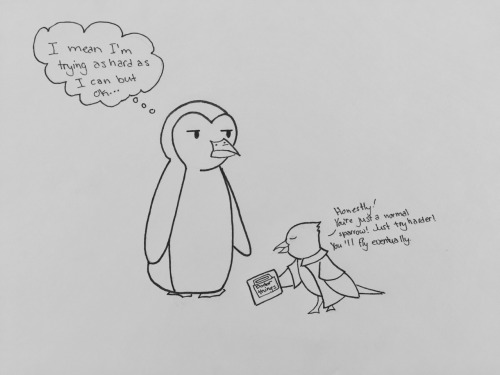
Imagine that you’re a sparrow, living in a family of sparrows in a town of sparrows in a world of sparrows.

But you’re kind of a shitty sparrow. Kind of the worst sparrow, actually.
You can’t fly. You’ve been to doctors who have prescribed medicine to help with flying. But you still can’t. You try every day, and every day you fail and this thing which all the other sparrows tell you is critical.

For a while, you stop trying. Failing every day just wore you down and you couldn’t do it anymore, so you stopped trying to fly. It was nice in some ways, but you felt guilty because you weren’t raised to give up. It made a rift with your family. Flying is an important activity that sparrow families do together. Isn’t your family important to you? Don’t they deserve for you to at least make the effort?

So since it’s nothing medically wrong with you, you go to a therapist, who diagnoses you with a phobia of flying. You work on overcoming your fear. You’re lucky, your family is very accepting of mental illness (other sparrows are not so lucky, and it hurts your heart to think about that). They appreciate and admire how hard you’re working. They try to include you, so instead of getting together and flying, sometimes they get together and all sit in their nests. That sort of sucks too, but it’s a definite improvement.

You continue to try, and fail, to fly. You try harder. You try as hard as you can. Sometimes you can’t even make yourself flap your wings, it’s just such pointless bullshit and you feel like you’ll never succeed. Sometimes you go up on a chair and jump off and flap real hard and go splat anyway.

Sometimes mean birds make fun of you because you’re a terrible screw-up.
For 26 years, this is what your life is.

One day, almost out of nowhere, as an afterthought, an aside, something barely worth mentioning because it is so obvious, a doctor says, “by the way, you’re a penguin.”

Holy shit. You’re not a failure. You’re a penguin. You’re not lazy or stupid or weak. You don’t have messed up values. You’re a penguin. You have always been a penguin.

There’s nothing wrong with you, you’re a beautiful penguin. The most perfect penguin. But it’s just a fact, penguins can’t fly.

Now when you’re with you’re sparrow friends and they’re all sitting in nests, you sit in a bucket of ice. Mostly you bring your own. Some bird restaurants are really accommodating and will bring you a bucket of ice to sit in. Sometimes mean birds give you shit about your bucket, but it doesn’t hurt as much as it did before, because you know you’re a penguin and you’re just exactly what a penguin is meant to be.

You give yourself permission to stop trying to fly. Not failing all the time improves your mood and overall function. You finally feel confident declining when invited to flying outings. You don’t waste the energy feeling guilty about it.

You love your family of sparrows, but you also find a whole community of penguins to love too. Things you thought were just you, like preferring fish to bird seed, things you thought you were totally alone in and wrong for, are common and accepted. Some are even admired. Your new penguin friends think your flippers and chubby penguin belly are lovely. You bond over how and when you discovered you loved swimming.

Knowing you’re a penguin means knowing where you fit in a world you never felt like you fit into. It means all the things penguins can’t do, it’s not a personal failing when you can’t do them. You’re not supposed to be able to. You can do other things instead. Sparrows are actually quite poor swimmers. You feel good about the things you excel at.

This is why I think labels are important. This is why I think “we’re all birds, let’s focus on our similarities instead of our differences” is harmful. This is how my autism diagnosis was like breathing, after holding my breath for 26 years.

We're Not As Divided As You Believe

K. Bron Johnson submits We're Not As Divided As You Believe from One Quarter Mama


We're Not As Divided As You Believe


If you speak to a lot of parents of autistic people, you'll hear many excuses for why they don't listen to us as authorities of the autistic experience. Aside from the whole, "you're not like my child" (well no, we've grown up), I'd say the most common way to try to discredit us is by saying our community is divided.

And I'm going to jump in here as someone who's very active in the community and say NO. That is not the case. If you choose to believe that, you're just making excuses. 


Read more on the original post  

The Case for Identity-first

Courtney Johnson writes The Case for Identity-first on Just Keep Stimming


The Case for Identity-first


[Note: this post is specifically in regard to the autism community.]
“You are required to use person-first in this class. Otherwise, it will affect your grade.”
I am autistic, not a person with autism.

I don’t “live with” or “suffer from” autism.


Autism isn’t a roommate that eats all the leftovers from my fridge, or a cursed plague rained down upon me from the sky. It’s not a death sentence, a condemnation to a life of loneliness and disastrous consequences.


The only thing I’m “suffering from” is the lack of acceptance and respect.


Autistic isn’t a bad word.


It’s an operating system, a lens from which I experience the world around me. It’s how I enjoy each moment, embracing my own existence in a way that many others do not. It’s not a disease, no matter what anyone says.


Neurodiversity is necessary in this world, and autistic people are not less for being themselves. All of us have value – the happy flappers, those who use AAC, those of us who can hardly remember to feed ourselves half the time (shout out to my schedule chart and phone reminders). Our lives might look a little different than yours, but that doesn’t mean it’s any less meaningful. Being autistic means I can be lost in the same musical pattern for hours. It means feeling joy so intensely that all I can do is flap my hands because the excitement over seeing a butterfly is just far too much to contain inside.


Sure, being autistic means shirt tags that feel like cacti pricks. It means intense fluorescent lighting, a rush of voices in the room that leaves your head swimming. The constant desire to know where my limbs are for grounding, the need for a human guidebook. It means feeling like an alien in a world that isn’t quite suited for my functioning needs. It means that I’m not really supposed to live on my own, that friends and others check on me regularly to make sure that I’m eating and looking after myself.


That doesn’t make me any less. Instead, it makes up my existence. Living in itself is full of positives and negatives; being autistic is the same.


We exist in our own way, and we deserve to exist.


If you need person-first language to remind you that I am a living, breathing human-being, we have an issue.  By enforcing the use of person-first, you immediately make the assumption that my disability makes me less – and something that you have to separate me from in order to have any worth in your eyes. You imply that I am broken, but you’ll try to make up for it by calling me a person first. At the same time, you completely contradict my entire identity and tell me that my voice does not matter.


My future kids are going to be loved. They’re going to learn that their disabilities make them unique, a beautiful boost to the natural diversity of humanity. They will learn that they are full of value – not despite their disabilities – but with the inclusion of them. I will teach them that their differences are needed in the world. In my home, office, or wherever I work some day, they will never need to feel ashamed of their existence.


In the community center I volunteer in, I take the same stance. Every single autistic child that enters that building is a precious soul who needs to be cared for and shown how important they truly are. The same applies for teens and adults, too. They are facing obstacles at every point of their lives, and we are all surviving in a world that doesn’t really take us into consideration.


In the meantime, I still have things to do.


It makes me feel like only the “professionals” get a say, instead of the people I am meant to serve in the future. I’m struggling through college for a reason: to help future disabled children and adults to take pride in who they are and love themselves. Part of that requires to respect their community’s wishes and their disabilities. If we teach our children that they have to be separated from their disability, doesn’t that further the stigmatization? Being a good advocate requires nurturing our kids, not to make them feel negatively about their existence.


It made me feel humiliated when the class was asked to explain why “an autistic person” is obviously wrong – immediately after I had mustered up the courage to speak up and say we prefer that. I cried after I left, because I felt disrespected and my experience as being a part of the autistic community didn’t count. It was as if my autistic voice didn’t matter, and conveyed the constant, overwhelming societal routine of ‘shut up, we know what’s best for you.’ It reminded me of all the times I was told I was broken and the world doesn’t think my words have any value. Of course, the professor meant well – person-first has been pushed on people for years. 


I sent the professor several links to studies, articles, and stances to back up my feelings. The next class, he actually took the time to explain to the class how there is a movement for using identity-first. The fact that he listened absolutely astonished me, and he’s been a fantastic professor all semester.


Most people are rarely as understanding as my professor was.


We fight so hard to be accepted and to be able to exist in the world. When autistics speak, few actually seem to listen.


If my voice isn’t good enough, maybe some of the following voices are:


https://www.ncbi.nlm.nih.gov/pmc/articles/PMC5545113/ : ‘The use of person-first language in scholarly writing may accentuate stigma’

https://www.thinkinclusive.us/why-person-first-language-doesnt-always-put-the-person-first/ : ‘Why Person-First Language Doesn’t Always Put the Person First’

https://autismwomensnetwork.org/failings-person-first-language/ – ‘The Failings of Person First Language’

http://www.autism.org.uk/about/what-is/describing.aspx – A link that describes studies and information.

https://musingsofanaspie.com/2014/06/18/the-logical-fallacy-of-person-first-language/ : ‘The Logical Fallacy of Person-First Language’

https://www.ncbi.nlm.nih.gov/pmc/articles/PMC3519177/ – ‘Person-first language: Noble intent but to what effect?’

http://aspitude.blogspot.com/2009/03/autism-first-language.html – ‘Autism-first Language’

http://doodlebeth.com/identity-first-language/ – A very informative comic

https://twitter.com/doodle_beth/status/899553495292026880 – informal Twitter poll that may be of interest.

https://www.eurekalert.org/pub_releases/2017-08/osu-sad082817.php#.WaSLL_syUzg.facebook – Disability pride and its effect on self-esteem.

http://www.autismacceptancemonth.com/resources/101-3/ways-of-thinking-about-disability/identity-first-language/ – Identity-first


As always, just keep stimming.

Of Acceptance and Kisses from Silver Charm

Carolina Rutz sents us Of Acceptance and Kisses from Silver Charm from An Aspie in Kentukia

Content warning: Ableism by religious authorities, suicidal ideation, self-harm


Of Acceptance and Kisses from Silver Charm

Since my end of my wilderness years, I felt that I have been reconciled to God and found acceptance as an useful contributing member of society. And I have the horse racing industry to thank.
When I was a hostess at the off track betting facility, I would welcome patrons to their seats and offered them water. After their meals, I bussed the tables. My Lutheran faith tradition informed me that the work I did is honorable and a service to God and neighbor. For a while, I was painfully aware that I was underemployed.
Then I looked at Facebook and read what my neurotypical Sem classmates went through since they got ordained. Some left the ministry after the abuse of their congregations and the indifference of their respective districts. Reduced wages and benefits. And to think I wanted to be a deaconess. One “Sister Of Blue” told me that she rather be back at her old secular job, but she felt compelled to remain. “Kid, you got a better path,” she said. I rather deal with dirty dishes whilst watching Santa Anita than to go what my classmates went through.
I feel at ease when I sit down at the bar, ordering Diet Coke and reading the Daily Racing Forms. I can speak and explain to patrons and friends better with the Racing Form in hand. Teaching people how to play the ponies became second nature over the months, and my bosses noticed that.

(Photo description: a display sign at a bar. The sign promoted “Carol’s Contest”, with a caricature of Carol with a cartoon horse.)

Understanding the female aspie in your life.

Paula Jones posts Understanding the female aspie in your life. on Absolute aspergers

Content warning for some gendering and medicalization


Understanding the female aspie in your life.

You might want to get a sandwich before you read any further, because this is going to be a long one.

Since finding out I have Asperger's, at the grand old age of 44, I seem to have forgotten all my previous coping strategies; well, most of them, and the real me has come out to play. This is not necessarily a good thing for the people around me, and until I can become reconciled to who and what I am, it's going to be a bit of a bumpy ride. If you have a female aspie in your life, then keep reading, because you owe it to yourself and to her to understand.