Wednesday, November 1, 2017

I’m Not “Other”, I’m Your Classmate

C.L. Bridge submits I’m Not “Other”, I’m Your Classmate

I am typing this sentence in my university’s library. I won’t be here much longer; I graduate in May. During my time in college, I have accomplished many things, socially and academically. As an art major and biology minor, I have a portfolio filled with creations I’m proud of, and I have worked with some amazing sea creatures.
Getting this far was definitely not easy. When I first started going to a community college near home, I took only two classes at a time because I got overwhelmed so easily. When graduation approached, I would cry for hours at least twice a week because I hate transitions and wasn’t even sure what I wanted to do next. And when I checked into the dorms at the university I currently attend, I was dismayed to find that despite a doctor’s letter  recommending a quiet dorm, I had been assigned a roommate who blared the TV at all hours. Even today, my conversations with my fellow students often involve stretches of awkward silence. I have a lot in common with the students in the New York Times’ recent article, “Along the Autism Spectrum, a Path through Campus Life”—because I’m autistic too.
And I want to tell you how I feel about that article’s portrayal of people like me.
I found the article’s tone needlessly condescending. From the very first sentence, a young man is defined solely by his lack of a girlfriend and his social awkwardness. We are never told his major, his interests and passions, his hopes for the future, or anything that might remind us he is as human as any other student. If the Western Kentucky University program hopes to help autistic students to make friends and thrive in college, it is ironic that an article describing the program “others” these students with its choice of words right from the start. As an autistic student reading these words, I am told that my presence on campus is “jarring”. And that hurts.

Even the program’s staff members seem to view the students as “other”. The program manager suggests that the autistic students who don’t feel lonely are less self-aware than those who do. Her remark that she is “too scared to ask” about graduates’ social lives despite their success in their chosen fields shows me that she has low expectations for the students. Believe me, I definitely worry about what will happen to my social life when I graduate—but when a
person supposedly trained to help people like me half-jokingly calls my future scary, I worry even more. The students’ conversations in the van are dismissed as non sequiturs, implying that their words are illogical and invalid. (What conversation in a crowded van doesn’t sound disjointed? And even if the students are talking nonsense, aren’t autistic people allowed to be silly sometimes?) When they return from their Walmart outing and forget to to say goodbye, the student mentor never considers that maybe it is because their minds are still jangled from the crowded, busy store. (I can tell you for a fact that shopping can be hard. I usually do fine, but sometimes when I go alone, my social anxiety gets so bad I leave without the thing I came for.)
Some of the strategies taught in the WKU program would have been helpful to me as a new student. Rehearsing what to do about a lost ID would have saved me a lot of panic. And I benefited from a community college class that taught study skills and organization. Structured, fun social events such as a game night help me make friends, and these events are one of my favorite things about college. And I’m sure all these aspects of the program help the participants too; I think it is great that the program got a young person out of a group home and into the community. But if I had the opportunity to join the WKU program, the forced socialization and condescension from staff and mentors would be enough to repel me. Does the program have any staff who are autistic themselves? If not, it needs them. We have firsthand experience with autism that no neurotypical person has.
I am writing all this because, as I’ve mentioned before, words and attitudes matter—often as much as actions. You can offer me wonderful support, but if that support comes with the attitude that my presence is jarring, that my future social life is too scary to talk about, that my words are non sequiturs, that I am other, then I don’t want it. Respect is an essential ingredient of any autism-related support I receive.

Sad Little Autistics Can't Get Girlfriends and That's Not a Bad Thing

Dani Alexis writes Sad Little Autistics Can't Get Girlfriends and That's Not a Bad Thing from Autistic Academic


Sad Little Autistics Can't Get Girlfriends and That's Not a Bad Thing


How many TV shows and movies now feature sad white cishet autistic guys who can’t get dates now? I’ve lost count.
Plenty has been written about tired-ass stereotypes in shows like Atypical and The Good Doctor, and I’m not interested in rehashing it here. Nor, to be honest, am I even particularly interested in revisiting the stuff on gendered expectations of dating and emotional labor that Emma and I did a while back (the first post of which is here if you missed that particular rabbit hole back when).
I am interested, on this year’s Autistics Speaking Day, in speaking about the following points:
1. Yeah, we flirt weird.
When I headcanon fictional characters (or real people) as autistic, it’s usually because I’ve noticed one or more traits:

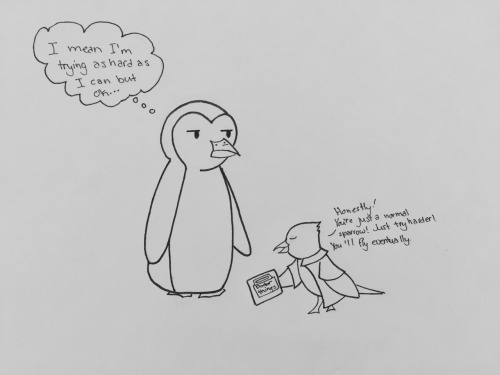
Sparrows and Penguins

An Anonymous Guest on Samantha Hack's Candidly Autistic has submitted Sparrows and Penguins


Imagine that you’re a sparrow, living in a family of sparrows in a town of sparrows in a world of sparrows.

But you’re kind of a shitty sparrow. Kind of the worst sparrow, actually.
You can’t fly. You’ve been to doctors who have prescribed medicine to help with flying. But you still can’t. You try every day, and every day you fail and this thing which all the other sparrows tell you is critical.

For a while, you stop trying. Failing every day just wore you down and you couldn’t do it anymore, so you stopped trying to fly. It was nice in some ways, but you felt guilty because you weren’t raised to give up. It made a rift with your family. Flying is an important activity that sparrow families do together. Isn’t your family important to you? Don’t they deserve for you to at least make the effort?

So since it’s nothing medically wrong with you, you go to a therapist, who diagnoses you with a phobia of flying. You work on overcoming your fear. You’re lucky, your family is very accepting of mental illness (other sparrows are not so lucky, and it hurts your heart to think about that). They appreciate and admire how hard you’re working. They try to include you, so instead of getting together and flying, sometimes they get together and all sit in their nests. That sort of sucks too, but it’s a definite improvement.

You continue to try, and fail, to fly. You try harder. You try as hard as you can. Sometimes you can’t even make yourself flap your wings, it’s just such pointless bullshit and you feel like you’ll never succeed. Sometimes you go up on a chair and jump off and flap real hard and go splat anyway.

Sometimes mean birds make fun of you because you’re a terrible screw-up.
For 26 years, this is what your life is.

One day, almost out of nowhere, as an afterthought, an aside, something barely worth mentioning because it is so obvious, a doctor says, “by the way, you’re a penguin.”

Holy shit. You’re not a failure. You’re a penguin. You’re not lazy or stupid or weak. You don’t have messed up values. You’re a penguin. You have always been a penguin.

There’s nothing wrong with you, you’re a beautiful penguin. The most perfect penguin. But it’s just a fact, penguins can’t fly.

Now when you’re with you’re sparrow friends and they’re all sitting in nests, you sit in a bucket of ice. Mostly you bring your own. Some bird restaurants are really accommodating and will bring you a bucket of ice to sit in. Sometimes mean birds give you shit about your bucket, but it doesn’t hurt as much as it did before, because you know you’re a penguin and you’re just exactly what a penguin is meant to be.

You give yourself permission to stop trying to fly. Not failing all the time improves your mood and overall function. You finally feel confident declining when invited to flying outings. You don’t waste the energy feeling guilty about it.

You love your family of sparrows, but you also find a whole community of penguins to love too. Things you thought were just you, like preferring fish to bird seed, things you thought you were totally alone in and wrong for, are common and accepted. Some are even admired. Your new penguin friends think your flippers and chubby penguin belly are lovely. You bond over how and when you discovered you loved swimming.

Knowing you’re a penguin means knowing where you fit in a world you never felt like you fit into. It means all the things penguins can’t do, it’s not a personal failing when you can’t do them. You’re not supposed to be able to. You can do other things instead. Sparrows are actually quite poor swimmers. You feel good about the things you excel at.

This is why I think labels are important. This is why I think “we’re all birds, let’s focus on our similarities instead of our differences” is harmful. This is how my autism diagnosis was like breathing, after holding my breath for 26 years.

We're Not As Divided As You Believe

K. Bron Johnson submits We're Not As Divided As You Believe from One Quarter Mama


We're Not As Divided As You Believe


If you speak to a lot of parents of autistic people, you'll hear many excuses for why they don't listen to us as authorities of the autistic experience. Aside from the whole, "you're not like my child" (well no, we've grown up), I'd say the most common way to try to discredit us is by saying our community is divided.

And I'm going to jump in here as someone who's very active in the community and say NO. That is not the case. If you choose to believe that, you're just making excuses. 


Read more on the original post  

The Case for Identity-first

Courtney Johnson writes The Case for Identity-first on Just Keep Stimming


The Case for Identity-first


[Note: this post is specifically in regard to the autism community.]
“You are required to use person-first in this class. Otherwise, it will affect your grade.”
I am autistic, not a person with autism.

I don’t “live with” or “suffer from” autism.


Autism isn’t a roommate that eats all the leftovers from my fridge, or a cursed plague rained down upon me from the sky. It’s not a death sentence, a condemnation to a life of loneliness and disastrous consequences.


The only thing I’m “suffering from” is the lack of acceptance and respect.


Autistic isn’t a bad word.


It’s an operating system, a lens from which I experience the world around me. It’s how I enjoy each moment, embracing my own existence in a way that many others do not. It’s not a disease, no matter what anyone says.


Neurodiversity is necessary in this world, and autistic people are not less for being themselves. All of us have value – the happy flappers, those who use AAC, those of us who can hardly remember to feed ourselves half the time (shout out to my schedule chart and phone reminders). Our lives might look a little different than yours, but that doesn’t mean it’s any less meaningful. Being autistic means I can be lost in the same musical pattern for hours. It means feeling joy so intensely that all I can do is flap my hands because the excitement over seeing a butterfly is just far too much to contain inside.


Sure, being autistic means shirt tags that feel like cacti pricks. It means intense fluorescent lighting, a rush of voices in the room that leaves your head swimming. The constant desire to know where my limbs are for grounding, the need for a human guidebook. It means feeling like an alien in a world that isn’t quite suited for my functioning needs. It means that I’m not really supposed to live on my own, that friends and others check on me regularly to make sure that I’m eating and looking after myself.


That doesn’t make me any less. Instead, it makes up my existence. Living in itself is full of positives and negatives; being autistic is the same.


We exist in our own way, and we deserve to exist.


If you need person-first language to remind you that I am a living, breathing human-being, we have an issue.  By enforcing the use of person-first, you immediately make the assumption that my disability makes me less – and something that you have to separate me from in order to have any worth in your eyes. You imply that I am broken, but you’ll try to make up for it by calling me a person first. At the same time, you completely contradict my entire identity and tell me that my voice does not matter.


My future kids are going to be loved. They’re going to learn that their disabilities make them unique, a beautiful boost to the natural diversity of humanity. They will learn that they are full of value – not despite their disabilities – but with the inclusion of them. I will teach them that their differences are needed in the world. In my home, office, or wherever I work some day, they will never need to feel ashamed of their existence.


In the community center I volunteer in, I take the same stance. Every single autistic child that enters that building is a precious soul who needs to be cared for and shown how important they truly are. The same applies for teens and adults, too. They are facing obstacles at every point of their lives, and we are all surviving in a world that doesn’t really take us into consideration.


In the meantime, I still have things to do.


It makes me feel like only the “professionals” get a say, instead of the people I am meant to serve in the future. I’m struggling through college for a reason: to help future disabled children and adults to take pride in who they are and love themselves. Part of that requires to respect their community’s wishes and their disabilities. If we teach our children that they have to be separated from their disability, doesn’t that further the stigmatization? Being a good advocate requires nurturing our kids, not to make them feel negatively about their existence.


It made me feel humiliated when the class was asked to explain why “an autistic person” is obviously wrong – immediately after I had mustered up the courage to speak up and say we prefer that. I cried after I left, because I felt disrespected and my experience as being a part of the autistic community didn’t count. It was as if my autistic voice didn’t matter, and conveyed the constant, overwhelming societal routine of ‘shut up, we know what’s best for you.’ It reminded me of all the times I was told I was broken and the world doesn’t think my words have any value. Of course, the professor meant well – person-first has been pushed on people for years. 


I sent the professor several links to studies, articles, and stances to back up my feelings. The next class, he actually took the time to explain to the class how there is a movement for using identity-first. The fact that he listened absolutely astonished me, and he’s been a fantastic professor all semester.


Most people are rarely as understanding as my professor was.


We fight so hard to be accepted and to be able to exist in the world. When autistics speak, few actually seem to listen.


If my voice isn’t good enough, maybe some of the following voices are:


https://www.ncbi.nlm.nih.gov/pmc/articles/PMC5545113/ : ‘The use of person-first language in scholarly writing may accentuate stigma’

https://www.thinkinclusive.us/why-person-first-language-doesnt-always-put-the-person-first/ : ‘Why Person-First Language Doesn’t Always Put the Person First’

https://autismwomensnetwork.org/failings-person-first-language/ – ‘The Failings of Person First Language’

http://www.autism.org.uk/about/what-is/describing.aspx – A link that describes studies and information.

https://musingsofanaspie.com/2014/06/18/the-logical-fallacy-of-person-first-language/ : ‘The Logical Fallacy of Person-First Language’

https://www.ncbi.nlm.nih.gov/pmc/articles/PMC3519177/ – ‘Person-first language: Noble intent but to what effect?’

http://aspitude.blogspot.com/2009/03/autism-first-language.html – ‘Autism-first Language’

http://doodlebeth.com/identity-first-language/ – A very informative comic

https://twitter.com/doodle_beth/status/899553495292026880 – informal Twitter poll that may be of interest.

https://www.eurekalert.org/pub_releases/2017-08/osu-sad082817.php#.WaSLL_syUzg.facebook – Disability pride and its effect on self-esteem.

http://www.autismacceptancemonth.com/resources/101-3/ways-of-thinking-about-disability/identity-first-language/ – Identity-first


As always, just keep stimming.

Of Acceptance and Kisses from Silver Charm

Carolina Rutz sents us Of Acceptance and Kisses from Silver Charm from An Aspie in Kentukia

Content warning: Ableism by religious authorities, suicidal ideation, self-harm


Of Acceptance and Kisses from Silver Charm

Since my end of my wilderness years, I felt that I have been reconciled to God and found acceptance as an useful contributing member of society. And I have the horse racing industry to thank.
When I was a hostess at the off track betting facility, I would welcome patrons to their seats and offered them water. After their meals, I bussed the tables. My Lutheran faith tradition informed me that the work I did is honorable and a service to God and neighbor. For a while, I was painfully aware that I was underemployed.
Then I looked at Facebook and read what my neurotypical Sem classmates went through since they got ordained. Some left the ministry after the abuse of their congregations and the indifference of their respective districts. Reduced wages and benefits. And to think I wanted to be a deaconess. One “Sister Of Blue” told me that she rather be back at her old secular job, but she felt compelled to remain. “Kid, you got a better path,” she said. I rather deal with dirty dishes whilst watching Santa Anita than to go what my classmates went through.
I feel at ease when I sit down at the bar, ordering Diet Coke and reading the Daily Racing Forms. I can speak and explain to patrons and friends better with the Racing Form in hand. Teaching people how to play the ponies became second nature over the months, and my bosses noticed that.

(Photo description: a display sign at a bar. The sign promoted “Carol’s Contest”, with a caricature of Carol with a cartoon horse.)

Understanding the female aspie in your life.

Paula Jones posts Understanding the female aspie in your life. on Absolute aspergers

Content warning for some gendering and medicalization


Understanding the female aspie in your life.

You might want to get a sandwich before you read any further, because this is going to be a long one.

Since finding out I have Asperger's, at the grand old age of 44, I seem to have forgotten all my previous coping strategies; well, most of them, and the real me has come out to play. This is not necessarily a good thing for the people around me, and until I can become reconciled to who and what I am, it's going to be a bit of a bumpy ride. If you have a female aspie in your life, then keep reading, because you owe it to yourself and to her to understand.


Sunday, October 15, 2017

Autistics Speaking Day 2017

Welcome to ASDay 2017!!! On November 1st, we'll be posting entries submitted by form and email. You can also get in touch with us by Facebook, Twitter, and Tumblr. 

Submission Form can be found here

You can also submit entries to AutisticsSpeakingDay at gmail dot com


Friday, October 13, 2017

Participants List 2016

Autistic 

Duke Rumbles. 

Cassie Autistics Speaking Day 2016: The Journey From Self-Loathing to Self-Acceptance and the Forging of Identity
Catsidhe On Autism and the sensation of Time.
Sara Kerkstra writes A Simple Desire (And other blogs)
C. L. Bridge My Personality Is Not a Sub-Type Presentation
Christy Walk I Am Autistic, and I am Valid (Trigger Warnings)
ActingNT (Daniel Au Valencia) Acceptance Must Not Become a Buzzword
Mx. Vera Didenko INFJs, Old Souls, and Vera
Leeanne Marshall An Unplanned Entry
Dr Levinstein I Will Not Rest
Julian Frost Autistics' Speaking Day: Autism in South Africa - an opportunity lost
Tuttleturtle Today I am silent
FeministAspie Autistics Speaking Day 2016: Affirmations For You
Kit Mead You call me expressive and miss the struggle it takes and On everything I love and want to succeed (Trigger Warnings)
Nora What Can I Say? (Trigger Warnings)
Michelle Sutton Autism does define me
Alyssa Silence of Absence
Neurodivergent K things you don't want to hear
Kris This Genderqueer Autistic is Speaking Out on Autistics Speaking Day (Trigger Warnings)
Dani Alexis Love's Austere and Lonely Offices (Trigger Warnings)
Caycilia Marble (A Poem)
Leia Solo Autistic Speaking
Michael Scott Monje Jr. That One Time I Had to Strike Against the IWW (Trigger Warnings)
R. Larkin Taylor-Parker Being a Welcoming Community
Nightengale Writing the Brochure I Want to Read in the World
NonSpeakingNonSilent i'm just going to be me and The actual Autism crisis
Amythest Schaber The problem is less that autistic people aren’t speaking, and much more that non-autistic people won’t stop.
Mintythings Authenticity (Trigger Warning)
Riki If you Value Autistics Return our voices
Kathryn Bjornstad-Kelly ASDay Post

Wednesday, November 2, 2016

Non Speaking Not Silent wrote "The actual Autism crisis" at Non-Speaking Not Silent: AAC Apps and Service Dogs


TW all the trigger warnings an.iesm, death abuse, and pretty much everything 


           There is a very real and serious Autism crisis


Yes we do have and Autism crisis and it seems t be an invasive epidemic world wide! But it's not what you think! 


The crisis isn't about "the rise in autism rates," something that is largely do to more awareness and understanding about Autism 


No the crisis  is invasive, frightening and dangerous 


The Autism crisis is....


Am invasive lack of presumption of competence especially when we do not have or use verbal communication or when our verbal communication is deemed poor


It's the assumption that those who do use verbal speech need few or even no supports at all,  and the reality their needs are often over looked, ignored and rarely accommodated


autistic communication rights are ignored, before we can have access to a full comprehensive AAC system we are often told to "prove it low tech first," when we don't use AAC 100 percent perfect right off that bay we are said to be in interested, many alternative communication methods are viewed as "con traversal and even when we are clearly typing on our own either the authenticity of out words or that of our diagnosis are called into question


The communication support needs of autistics with decent to excellent verbal skills is overlooked and ignored entirely


The fact that communication and verbal skills are seen as binary concepts


The fact that access to communication AIDS and a variety of methods of non speech based communication methods isn't seen as a basic human right for us,


The fact that people assume we don't communicate if we can't use or don't use verbal speech or an AAC 


The fact we have to remind people behavior is communication 


That children are expected to spend 40 plus hours a week in therapies designed to try to make us  indistinguishable from our peers or as normal as possible while also getting other therapies and being expected to also go to school, childhoods stolen in hopes of making us seem normal 


A growing number of dangerous and experimental treatments and abusiveAnd therapies in hopes of curing us, many of which would be considered child abuse with a non autistic child, prominent example is mms (mini ale mineral solution aka bleach fed to children and administered though enimmas  


The fact that autistic friendly therapies are not seen as a priority and learning to pass as normal is even at the detriment of the autistic individual


The fact RPM isn't more widely available and I'm not sure if insurance will even cover it


The fact that stim suppression is considered a training goal even though stimming is critical for many of us


The fact that essentially dog training techniques are used as therapies on us to train us to act normal.


The fact there are therapy goals at teaching us to play "the right way" (aka the non Autstic way)


The fact it's seen as acceptable to talk about us like we aren't Ben there when we are next to you!


The. Fact that proper clump comorbidy in with being part of autism and don't look at them separately as additional things we have to deal with,


The fact that organizations that claim to represent while ignoring us when we say something is harmful and they will try to silence us and claim to speak for us while shutting us out, spreading fear and stigma. 


It's the attitudes that murdering us is some how mercy, while our killers often parents and care givers  are painted as victims and us the undo burden who they had to endure,  our support needs and challenges are used to justify our murders,  that when we are murdered the reports aren't about how it is an unspeakable act of cold blooded murder but rather about the struggles of our killers, 


The fact society seems to send them message we and our loved ones are better off if we were never born or if we are dead


The fact that we have to fight for our basic human rights and those are often ignored.


The fact that parents showing videos of us at our worst  to "educate" by posting about how hard and horrible autism makes their lives is seen as acceptable and our dignity and privacy not being valued especially in the face of parents talking about their suffering


The fact parents suffering matters more then the Barrie's that we face due to ableism and a societies attitudes about us


The pervasive use of functioning labels that paint an inaccurate picture about an autistic individual and our needs, capabilities and assets, 


The using of functioning labels to silence and function shame autistics 


The fact that being able to type is used against us to invalidate out voices especially if we type well (spoiler how well we type tells you nothing about what challenges, daily struggle S or impairments we have)


The fact that any small success or having certain life skills even if they are not as important as ones we struggle with is s used against  us to silence us 


The fact that functioning shaming is a thing 


The voices of Parents " professionals and organizations being valued over those of actually Autistic people 


The mere fact an autistic person can disagree with something or say "wow that's harmful," or "how would you feel if that was up you," to things like meltdowns p or personal care things being put out on the Internet for the world to see and 100 parents will jump in and attack or harass the autistic person, really all an autistic person needs do is disagree with the something posted by a parent, org or a non autistic and they get attacked.
The fact that there are amazing parents and family members out there who work to lift up Autistic voice, support neurodiversity fight for presumtion of comptenence fight agaisnst all the issues on this list to better the lives of their children and loved ones only to also be dismissed and told they have it easy and clearly don't know what "real autism is,'

this whole "this is real autism," thing often used by people who feel autism isn't being portrayed right often used as an attack on what they see as ?to happy a depiction" and ignoring the fact that autism is complex.


Autstic adults and children are constantly exposed to hearing terms like "burden," "crisis" "Broken," "lost," damaged and "trapped" in reference to us and being autistic and this is seen as ok while "valued," "competent," "life worth living," "being seen as a whole person," and any discussion of acceptance and understanding is seen as"glorifying autism," controversial and radical 


The fact that people take offense to the Neurodiversity movement that basically say different neurology and disability is part of human experience, disabled people and people with different neurologist have a right to our basic rights, understanding  supports we need and acceptance for who we are and it's ok to have different neurological make up and to have disabilities what ever they may be it doesn't take away from our value as a person


The insistence one use of mental age


The idea IQ test accurately determine anything really.


The fact that most of the funding for autism goes into studies about causes, prevention and prenatal testing instead of into studies on what services and community supports are most beneficial to autistics, to adult services and community support or to services for adults
The fact that April is often a traumatic time for Autistics as we are looded with harmful awareness adds that stigmatize us, stories of our peers treating us as humans and being praised for it and inspiration porn, and of coarse lets not forget the light it up blue which is a giant add for autism speaks that  the autistic community has addressed as harmful and is the center of a massive boycott,

The fact that the autistic run and founded events in April for acceptance and understanding such red instead, the blog challenge, and a variety of alternatives to light it up blue are generally ignored drowned out by the things lifted above


The fact that services and supports for autistic adults especially in community supports are rare and hard to find 

The fact most services cut off at 22
The fact most organizations providing service dogs for Autistics will not train them for adults and many are either scam or well intentioned but promoting and using practices/tasks such as tethering that are highly dangerous to both dog and he autistic individual. Even though there are a variety of tasks  that guide and hearing dogs perform that can really help mitigate and manage sensory processing issues.


The fact that poor families, families of color and minorities and females are less likely to receive an autism diagnosis and the gender and cultural biases in the diagnostics and the autism field


The fact most people think of autism they depict a white male child often sad looking


The fact that even though every other disability community has pretty much realized  negative awareness techniques and using pitty to get funds was wrong and damaging so they did away with it like in the 60s or 70s (it's 2 am I don't have the exact date more the spoons to look it up) up yet this is the main way fundraising is done in the autism community 


The fact that electro shock is seen as a reasonable way to treat autism and is just reaching the fear in hopes of having it banned as I humane in the year 2016! Please FDA ban aversive shock therapy!


The fact sensory issues are rarely taken seriously 


The fact that non autistics are praised for treating us like people


The fact we have to fight to be seen as humans 


The fact that passing means our diagnosis is devalued and not means we are denied  out autonomy 


The fact that our sexuality is ignored
the fact that we spend hours in compliance training

the fact that having emotions such as anger, frustration and being upset while normal for everyone else is seen as being defiant and uncooperative,


The fact that autistic is used as an insult now by some


The fact that use of autistic is ignored and even painted are therapy 


The fact that when autistic choose to use identity first non autistic people correct us and tell us how to talk about ourselves and insist we use person first.


The fact we are often given little to no autonomy 


The rampant infantalization of autistics


The fact doctors still tell parents if we don't do X by age 5 we never will 


The fact that the entire focus is to make us normal and not to accommodate us and help us grow with our strengths
The fact you can be denied an organ transplant because you are Autistic

the practice of forcing eye contact


The fact that the world tells us it's better we pass and burn ourselves out completely then we seem even a bit Autistic


The fact that our accommodations and needs aren't taken seriously and are often treated as not real or a burden


The fact that we are seen as tragedies not people 


The fact it's 2-3:30 am  and I can rattle these off the top of my head despite being half awake!


I know I am missing so many more!


This is the real Autism crisis

 The real Autism crisis is how society treats us the Autism crisis is Ableism!

this is a crisis we must address and needs to be dealt with!

this is the Autism crisis Autistics face everydaay!


Image description white Germany Shepard wrappers in 2 blankets laying on a brown leather couch with head  on a white pillow dangling back over the side of the couch

ASDay Post

Kathryn Bjornstad-Kelly writes "ASDay Post" at Katy Doesn't Live In Smithton.


I don't even want to think about how long it's been since I've posted here.
And I didn't want to think about how long it had been since I'd been involved with Autistics Speaking Day, or any sort of activism, when I talked to Corina again.  I mean, it was no secret that I had stopped doing pretty much everything that I used to do.  I had helped popularize ASDay, but now I had started avoiding it every year, as it arrived and on the actual date and as it passed.  Too much depression and anxiety.  Too much self-loathing.  Too much doubt.  Too much panic that welled up inside me anytime I tried to do anything that made me feel like maybe I was a person.  Too many voices telling me, "You'll never be good enough."

But that wasn't who I wanted to be anymore.  On new medication, I was doing a lot better, and starting to enjoy life again.  I had been spending time through the past few months fixing all of the problems that I used to spend hours worrying about, and it was making life better for me.  And I was not going to be afraid of Autistics Speaking Day forever when it could be fixed, and I could have what I wanted and I was capable of doing the job.  So ignoring the tangled pit of fear and doubt in my stomach, I sent Corina an IM.


Read the rest here!

If You Value Autistics, Return Our Voices

Riki wrote "If You Value Autistics, Return Our Voices" at ZebraRiki.


(Note: I started this on Monday, but then I was too exhausted to finish it, so I’m posting it a day late)
Today is Autistic Speaking Day.

It’s Autistic Speaking day, and my friend and colleague is in Ottawa at a National Youth Forum discussing what an accessible Canada would look like.

It’s Autistic Speaking day and just yesterday I rolled into a theatre, saw my name on a sign as the guest speaker, and reflected on the collaboration we had we done with the theater company and the amazing work that has been done this past year.

I’ve spoken at the United Nations in Geneva, made UN submissions as an autistic person representing autistics, been involved in National Campaigns,

and you know what?

this morning my phone broke even more, and I cried.

I pressed the non-responsive buttons repeatedly as if they some how held the answers I desperately needed.

I stared at that broken phone in disbelief and all the exhaustion came rushing back.

I’m so tired.

Last night was amazing.  It was amazing and I was preparing to write a very different post for today.  I still want to write that post.

But this one, this is something I have been putting off for so long.

A few weeks ago when  I spoke at the consultation for the Canada Accessibility Act, I first spoke on the barriers I was facing as I was working to be involved in advocacy (and other things).  How having a disability, especially multiple disabilities, impacts how you are able to deal with your disability.  How being poor, not living in acccessible housing, and not having access to necessary medical supplies has left me with constant health problems in addition to what I normally deal with.  How I struggle to fill out forms so much that it is often easier for me to simply go without, how this means I miss out on constant opportunities.  Everything I accomplish takes so much out of me that I return exhausted, with less energy complete necessary functions others consider simple.  With increased damage to my body.

I have failed disability studies courses 5 separate times.

That’s a different post, but it’s important because I so often see amazing disabled people pushed out of the field, their experiences enriching their non-disabled classmates, who go on to graduate and find jobs in the field,

while our expertise is overlooked and miscredited, and if we are lucky enough to get paid (we usually are not), we are frequently underpaid.  Our involvement is not considered serious, or work, or something worth paying for.

This needs to change.

I love what I do, and yes, the stress, the tears, all of it is worth it.

But here is the problem.

I don’t constantly cry about money just because it would be easier for me and others,

I do so because I have been barely able to hang on for several months now.

I have some of the most amazing people in my life, and their support, their love, hope, optimism, that allows me to keep mine.  Because my life is filled with such amazing people, I’ve spent the past few months trying to drag myself through this, knowing that there can be something in the future.

With all the talk that everyone does about Autism, how much money raised goes to support Autistics?  And actually support them, not just fund questionable therapies.  How much money goes to us, the Autistics working so hard for this.  We don’t do it for praise, we often get dragged through the mud by so many people for this work.  We put our reputations, our sanity, ourselves, on the line for this because we know they never  mattered in the first place.

And all I want is for someone else to not have to make the choices I’ve had to make.  To not have to try to balance a non-existent budget but then find out too late that when you don’t eat because you ran out of food, it’s impossible to work.

I don’t want people having to triage emergencies, because everything is urgent.

I don’t want people losing themselves because it’s hard when you don’t have time to process your own trauma and tragedy.  To deal with it.

It’s terrifying to make decisions that will be better for you and your community in the long run but right now, oh right now they hurt.  They hurt so much.  And yes, yes they are worth it.

But that doesn’t make them hurt less.

I do not regret my decisions.

But sometimes I have to take a moment and just acknowledge the weight of them.  It’s how I stop it from crushing me.

So I am writing this because the last year has been amazing but also terrifying.  I wouldn’t have made it without having such an amazing group of awesome supportive people in my life.

But I can’t keep running on empty.

I think I can because I’m so used to it.  But I can’t.

And this is relevant to you, to others, because I have a lot to give, a lot that I can do.  It’s not the same situation here in Canada.  I’ve tried to replace me before, but we’re not yet there.  (Trust me, there was a whole month long thing where I cried a lot and was willing to put myself in a very questionable position Patreonbecause we couldn’t find a replacement me for something yet).

So what I’m asking for, is help.

especially to non-Autistic people, stop donating to large non-Autistic orgs and consider donating to self advocates.

Stop stealing our voices

Give them back.

If you are able, (and I know, times are very hard right now, for us all), I’m setting up some fundraisers,

No obligation, No pressure, but if you are interested,

I have a YouCaring page, and also a Patreon